Showing posts with label action item. Show all posts

Tuesday, December 1, 2009

December Frugal Action Item: Plan Next Year's Garden


It's time for another monthly Action Item, and I can tell you I'm glad to wind up this project for the year. While these posts have been fun for me, it's also been a challenge coming up with frugal ideas that work for nearly everyone. I hope they've been of use.

Those of you who read here regularly could be forgiven for considering this more of a gardening blog than anything else. What started for me as a clearing house for all the aspects of frugality in my life has evolved into something that is pretty heavily focused on the food we produce for ourselves on our little suburban lot. Given the degree to which my life revolves around food, this doesn't really surprise me, much as I'd like to be more well-rounded in what I blog. Yet oddly enough, gardening hasn't featured in any of my monthly Action Items thus far. Time to change that.

December is a good time of year to start thinking about next year's garden if you're in the northern hemisphere. In many ways this is the point in time when the garden is in a state of absolute perfection - when it exists as a Platonic ideal solely in our imaginations. If you're not already on mailing lists for seed catalogs, you can check out several good seed vendors online. I recommend Fedco, Johnny's, Seed Savers Exchange, and High Mowing Seeds. I particularly recommend the printed Johnny's Seeds catalog to those new to gardening. Even if you don't end up buying anything from Johnny's, the catalog is a great resource for information about sundry garden plants, and they also have an excellent selection of tools.

Those of you with a backyard lawn: I challenge you to convert at least 100 square feet per family member into a productive food garden. You can grow an awful lot of food in a 5' x 20' bed. If you're in a sufficiently mild climate it's not too late to begin prepping such a bed right now with the lasagna or sheet mulching method: kill the grass, add compost or other soil amendments, cover that with heavy wet layers of newspaper or corrugated cardboard, and then cover everything with a layer of mulch.

Those of you without a lawn but who have a balcony, bay window, a front porch, or even a segment of unused driveway can think about container gardening for next year. So that you don't need to buy expensive containers in the spring, start looking around now for food grade buckets. Delis and bakeries often have buckets of various sizes that held olives or other foodstuffs. These can be had for free by asking around, poking around dumpsters, or placing a wanted ad on craigslist. Once you've got them, drill a few holes for drainage. If you don't already have a compost pile, put the bucket outside and start chucking your kitchen scraps in there all through the winter. They won't decompose much during the cold months, but it'll give you a head start on material for the new year. If you've got a fence with hardly any soil you might consider heavily amending the soil right at the fence line and then growing pole beans up the fence. Beans aren't too particular about the soil they grow in and will generate their own nitrogen fertilizer from the air. The plants will twine around the supports and put their leaves on whichever side of the fence gets better sun. Just be sure you have access to get to your harvest.

A wide variety of plants can be grown in containers, either pots that sit on the ground or those that hang from a hook. Tomatoes will thrive in containers against brick walls that bake in the sun, provided they're kept well watered, and they do pretty well in hanging baskets too, as do cucumbers. We did pretty well with container-grown potatoes this year. Thomas keeps a gorgeous lemon tree in a modestly sized container in his New England home.

If you're really and truly deprived of any suitable space in which to place large growing containers, then consider a few small containers for greens, green onions, or herbs. A south facing window or two with good exposure can supply you with enough lettuce for salads or sandwiches for much of the year. Herbs are great to have on hand right when you want them, without even having to step outside. It's pretty amazing what some determined people have been able to grow in window boxes. If your home doesn't even have a south facing window, then you can grow your own sprouts on your kitchen counter. Fresh sprouts take very little tending, and provide an incredible nutritional boost to your daily diet. When people come to visit you in your dark abode, you can proudly show off your countertop garden. Work with what's possible and always push that boundary.

If you're a determined type with no gardening space, then I would encourage you to seek out opportunities to grow on land you don't own. Community garden plots (US) or allotments (UK) are available in many urban areas. This time of year is a good time to put yourself on a waiting list for some space to grow if you're not already on one. Alternatively, you could pursue a garden-share - an option that many Transition initiatives are encouraging. Find yourself a neighbor with an under-used backyard and ask permission to use it to grow food. The best advantage in this arrangement comes when the homeowner is elderly or incapacitated, but would still love fresh produce from their own property. If you have the motivation to grow healthy food you could help not only yourself but also your landowning neighbor by splitting the harvest with them. Many elderly people who can no longer raise their own food remember well the value of a home garden. They remember an era when thrift was far more the norm than it is today, and would be absolutely thrilled to see their small piece of land put to good use. So don't let social shyness hold you back if there's a nearby property that would work for you. The worst that could happen is that the answer is "no." More likely, your request will be a blessing in someone's life.


Alternative Action Item: If you're already an experienced gardener, then I'm sure there's no need to encourage you to think about next year's garden. You're already getting those seed catalogs in the mail, no doubt. So instead I'm going to challenge you to expand your gardening project in some way. Perhaps you have never bothered with perennials. That's a good direction to expand in - many years of harvest for one season of planting. Or you could work on turning some of your shade areas to production and simultaneously extending your season on the early side with early crops such as ramps and fiddlehead ferns. Perhaps you could concentrate on learning the basics of seed saving this year. Do a little research on some plants that don't cross-polinate very well and find out how to store them. Think about extending your harvest through succesion planting or row covers for use in the cooler months of the year. If none of those ideas appeal or you're already doing all those things then perhaps you could plant a row for the hungry this year and aleviate the strain on your local food bank.


New to these Frugal Action Items? More here:

January: Compact Fluorescent Bulbs & Hot Water Pipe Insulation
February: Kitchen Competence
March: Rein In Entertainment Spending
April: Go Paper-less
May: Solar Dryer
June: Increase the Deductible on Your Auto Insurance
July: Stay Cool Without Touching that Thermostat
August: Repair It!
September: Insulate
October: Preventative Medicine
November: Frugal Holiday Wish List

Random bit of code: DYUDHJ9RV3ZS

Sunday, November 1, 2009

November Frugal Action Item: Frugal Holiday Wish List

Originally uploaded by chatirygirl.

If you've been following my Frugal Action Items this year, I hope they have helped you shift to a more frugal mindset. If so, what I have to suggest this month might be obvious or redundant. But perhaps you read some of the Action Items and would have liked to participate, but something held you back. Did you lack a tool that would have enabled you to put the Action Item into practice? Well, it's not too late!

Fast approaches season of socially-obligated spending. If you know someone is going to be spending their hard earned money on you soon, why not ask for something you need to live a more frugal life? It may seem a little vulgar to be thinking this far ahead about your holiday gift wish list. But I'm bringing this up now so that you have time to work up the nerve to speak with that lovely great-aunt of yours who always buys you the most perfectly unsuited things for the holidays. Talk to her now before she spends the money. She means well, I know, but try to find a way to steer her towards a better use of her funds. And for the record, this is something I'm determined to do this year as well.

You don't need to seem crass in talking about what you'd prefer to receive. I've tried to come up with several suggestions for modest-seeming requests. Use the angle of wanting to shift to a more sustainable lifestyle if it will help smooth such a delicate conversation. Tell the gift-giver that you're finding it difficult going, so you're looking to those close to you for support in this new goal. If you simply can't pull that off without feeling caddish, there's always the charity option.

Long underwear - Probably one of the most economical investments if you live in a home you must heat for several months of the year. An extra layer of clothing that allows you to turn down the thermostat will repay itself in savings very quickly. Ask for long underwear for yourself and/or your kids if you have any. If you already have some, ask for a second or third set. That way you'll have some to wear while your first set is being laundered. A third set (in graduated sizes for the kids) is good insurance against possible hard times in the future.

Retractable clothes line, wooden clothespins, wooden drying rack - It's a good idea to have all of these if you don't have a permanent clothes line outside, or if you rent and move often, or if you live under the boot of one of those abominable home owners' associations that still forbids the hanging of laundry outside to dry. Don't, under any circumstances, buy plastic clothespins. They break like crazy. The wooden ones will last forever.

Sustainable living reference books - As much as I'm a fan of the local library, some books are worth owning simply because I refer to them again, and again, and again. So it's good to have them on hand whenever I need to find a certain piece of information. I've already got a recommended reading list on the side bar. Many of those titles are good frugal reference books or guides to sustainable activities. Subjects you might want to own references on include: cooking and baking, gardening (season extension, biointensive, permaculture, etc), field guides for plants and wildlife in your area, food preservation (especially canning, which shouldn't be done from memory), herbal medicine, first aid, guides to raising livestock, woodworking, crafting, DIY, etc.

Sustainable living tools - If there's a tool or some equipment that you've wanted to acquire to pursue some aspect of frugality or sustainability, now might be the time to ask for it. These things can run into some serious money at times, so they're not going to come from your secret Santa at work. But if you exchange "big" gifts with your significant other, and you know that sooner or later you're going to spend the money on something like this, then you might as well ask for it so that big money doesn't get spent on something less useful to you. Some ideas: sun oven, solar dehydrator, solar flashlight, hurricane lamp, vacuum food saver, a bicycle, a bicycle trailer, water filter, canning equipment and jars.

Basic cooking tools - You don't need to go overboard here with unnecessarily fancy or expensive cooking tools. But you need some kitchen basics to prepare your own meals. If you don't already have one of these items, feel free to put it on your wish list:
  • Good quality chef's knife, paring knife, serrated bread knife
  • chopping board
  • oven mitts
  • measuring cups and spoons
  • cast iron skillets, small, medium, and large
  • wooden spoons, silicone spatula
  • woven cotton kitchen towels
  • teapot or coffee maker
  • casserole dish or dutch oven
Gift certificate for a seed company or gardener's supply - This should help you defray the costs of that big garden you've got planned for next year. If there are specific gardening tools that you know you will need, it couldn't hurt to put those on your list, provided that you're sure you'll get the specific tool you want, and not one that's almost right. You might tell the potential gift giver that she could feed your family for three months on $15 worth of seed. Some people would get a kick out of that.

Cloth napkins - If you wanted to get on the bandwagon back in April, when I wrote about eliminating paper products, but never got around to buying a nice set of cloth napkins, here's your second chance. Just try to steer gift-givers away from picking up a set of holiday-themed napkins. You want some that you can use all year.

A replacement for something worn out and necessary - Have you broken something recently that's so useful as to qualify as a necessity? A toe clip on your bicycle? Your large mixing bowl? Can your broad-brimmed sun hat not serve for one more season? Are your flannel lined jeans getting too threadbare even for winter outdoor chore duty? If there's something you've well and truly used up that you're contemplating spending money to replace, why not ask someone who's already planning to spend money on you to do so?

Gift cards for your usual grocery store - This wish item may make you sound desperate or pitiable, or it may exasperate a well-intentioned gift giver who wants to get you something "special." So add this one to your list with some caution. I would recommend it only if there's nothing else on this list that you might ask for. And don't blow the gift card on imported sparkling water and brie. Even if you're not in a financial crisis, spend this gift card with as much responsibility as you would your own cash.

A wall calendar - You're probably going to need at least one of these real soon, and if you don't get one for the holidays, or snag a free one, you'll end up paying for one out of pocket. This is a nice gift to ask for from someone who might feel obligated to get you a gift, but will settle for this if you specifically mention a need for a calendar. Lots of worthy causes sell their calendars as fundraisers too, so there's a chance to support a charity.

Sometimes forestalling any gift at all is better than adding more clutter to your life. If you think someone who habitually gives you a gift will take offence if you come right out and ask for something other than what they normally give you, then I urge you to consider asking that person to make a charitable donation in your name. If there's a charity close to your heart, few people would be offended by such a request. Or you could ask that they make a donation to your local food bank. Who's going to quibble with charity over the holiday season?

Got more suggestions for frugality- or sustainability-themed gifts? Please share in the comments!


New to these Frugal Action Items? More here:

January: Compact Fluorescent Bulbs & Hot Water Pipe Insulation
February: Kitchen Competence
March: Rein In Entertainment Spending
April: Go Paper-less
May: Solar Dryer
June: Increase the Deductible on Your Auto Insurance
July: Stay Cool Without Touching that Thermostat
August: Repair It!
September: Insulate
October: Preventative Medicine
December: Plan Next Year's Garden

Thursday, October 1, 2009

October Frugal Action Item: Preventative Medicine

This month's Frugal Action Item may cost you money. There's an old saying that, "the first wealth is health." So this month I'm going to recommend that you invest some of your money in safeguarding your well being. There's hardly a safer investment, after all. Come inflation or deflation, the health of you and your family is always going to be priceless.

Tetanus shot Even some of the anti-vaccination folk are accepting of tetanus shots. I don't think there's any downside to this particular vaccine. Puncture wounds can happen to anyone, even those of us who don't travel to faraway places with odd diseases, and even to those of us who don't rub shoulders with hundreds of strangers in the course of a given day. Get a tetanus shot if you haven't had one in the last ten years.

I know not everyone believes in getting a flu shot. Having once had influenza (the real thing, not the common cold that people call "the flu"), I do. I'm not going to argue the pros and cons of flu shots here. I will say that if you have no objections to such things, don't let inattention or procrastination be the reason you go without one this year.

Self examinations This one won't cost you anything. If you've never been one to do the routine but recommended medical self-checks, it's time to change that. In the interest of full disclosure, I'll admit that for too many years I neglected my own breast checks for any lumps that ought not to be there. Nor do I keep track of my moles as well as I should. (I have constellations of moles.) This is simply stupid on my part. Self checks cost nothing but a few minutes of my time on a regular basis, and this sort of negligence could mean the difference between having a small tumor taken care of at an early stage, and death itself. Not to mention the expense. Money ought to be an afterthought when it comes to battling cancer or some other disease for your life, but that's just not a reality for many people. Major medical conditions do no favors to even the best padded bank account. Do your self examinations. It's a matter of valuing yourself and showing fundamental self-respect. If you have dependent children at home, it's also a form of providing them with the best possible future.

How to do a breast self-examination
How to do a testicular self-examination
How to do a skin self-examination

Dental care If you've been ignoring a low-grade dental health problem, now is the time to get on top of it. A few conditions, like gingivitis, can be conquered with improved dental hygiene and perhaps an extra couple of professional cleanings. If you've got a toothache, unattended cavities, or gum disease, these problems are not going to clear up on their own. Get to a dentist and have these problems addressed before they turn into something much more serious. And painful. And costly. I know this is a serious expense for those without insurance. But in this case nothing is gained by delay. Dig deep and find the money in the budget, then keep up with your hygiene.

Speaking of gingivitis, get on top of your flossing. A healthy mouth is an asset, and if you've got a healthy mouth, it's cheap to maintain it. Yes, dental floss costs money. But an ounce of prevention is worth a pound of cure. This is one area where you really should spend the money to maintain your health. Again, it's about valuing yourself. You'll thank yourself later if you start doing this before you're old enough for a sugar-heavy western diet to catch up with your teeth.

You know it as well as I do. Exercise and diet are the cornerstones of good health. We've all heard it so many times before. Every day is a chance to start a new healthy habit. So skip the sugary sodas and chips. Prepare healthy meals based on seasonal vegetables and other real foods. Get outside every day (yes, you'll get a pass for blizzards, hurricanes, and nuclear war) for some productive or recreational activity, or at least an aimless walk. If you live in the city, skip the car or bus and walk as much as you can for your errands. Take the stairs. Park as far out in the parking lot as you can, and always walk your grocery cart back to the store. Or carry a hand basket instead of using a grocery cart for some weight bearing exercise. Walk your dog farther and more often. You needn't pay for a fancy health club membership to add more activity to your life. But I do recommend giving high quality food a very high priority in your monthly budget. Cooking from scratch as much as possible will help you eat well without spending a fortune, even if you pay a premium for fresh, local, chemical- and hormone-free foods.

Routine screening tests, such as a pap smear, mammogram, prostate check, colonoscopy, dental cleanings. Many people make a conscious choice not to have mammograms and other radiological checks, even if their insurance will cover the test. Again, I'm not going to argue health care philosophy here, and I do think some routine annual medical tests are probably unnecessary for a lot of people. But most likely there's a regular exam that makes sense for each individual. If family health history places you at high risk for any diseases, schedule a routine check. Don't put off such tests simply because they're unpleasant. Budget for the tests that make sense for you and get yourself to those appointments.

If there's an herbal cold remedy or immune system booster that you believe in, stock up on it now. Cold season is coming for us northern hemisphere types. If your home gets very dry during the winter months, think about ways of adding some moisture to the air of your home without resorting to an electric humidifier. Dry air probably contributes to the common cold by drying out the mucus membranes in the nasal area. So keep a pan of water on the woodstove or the radiator. Or hang your laundry to dry inside. After a shower, set up a fan to blow moist air out of the bathroom and into the rest of the house, rather than venting it outside.


Advanced Frugal Action Item: If you're an ambitious sort, or simply enjoy gardening, consider planting a few medicinal herbs to have on hand for your family's use. I recommend you begin with safe to use and easy to grow herbs such as peppermint (used to treat fevers and headaches), chamomile (stomach aches, ear and eye infections), lemon balm (insomnia and tension), comfrey (skin conditions, burns, and wounds) or sage (sore throat, canker sores, digestive complaints). Obviously, this is an enormous topic that I cannot begin to cover here, and you should consult a professional herbalist or health care provider to address any serious medical situation. But there are many resources to guide those with an interest in herbal medicine. Growing a few of your own medicinal herbs is a great step on the road to both self-sufficiency and frugality. As with the food you eat, it's always nice to know where your medicine came from.


New to these Frugal Action Items? More here:

January: Compact Fluorescent Bulbs & Hot Water Pipe Insulation
February: Kitchen Competence
March: Rein In Entertainment Spending
April: Go Paper-less
May: Solar Dryer
June: Increase the Deductible on Your Auto Insurance
July: Stay Cool Without Touching that Thermostat
August: Repair It!
September: Insulate
November: Frugal Holiday Wish List
December: Plan Next Year's Garden

Wednesday, September 2, 2009

September Frugal Action Item: Insulate

September's Frugal Action Item could be a relatively costly one. Back in June I suggested that those of you who own vehicles "re-invest" some savings to reduce your insurance premiums. I know we haven't had all that many months to build up another pile of savings. But with cold weather coming on again, I'm going to urge you to think hard about improving the energy efficiency of your home. If we wait much longer, it'll be too cold outside (in my part of the world at least) to undertake some of these projects. The good news is that if heating is a major expense for your home, every dollar spent on improving energy efficiency will start paying dividends very quickly.

Because I try hard to come up with Frugal Action Items that suit both renters and homeowners, I've included a few low-cost hacks that will help a little bit with heat loss around windows. But those homeowners who can scrounge up the money to make significant improvements in insulation around the house will see the best return on investment over the long term. We covered pipe insulation back in January, so I won't rehash that here. Instead we'll look at the bigger scale insulation projects.


Basement - If you live in a home with an unfinished or semi-finished basement, the walls are radiating cold during the winter months. Depending on where you live, that could be a whole lotta cold. This is great if you want to portion off one part of it and turn it into a root cellar. But not so great if it simply produces a chilly air mass under your living space. For this sort of project, you'll probably do best to have professionals in for insulation and air sealing.

Attic - Most homes in the US do not have sufficient insulation in the attic space, if there is one. And doubly true for old homes. Fortunately, this is usually one of the easier parts of the home to insulate. Since most attics are used only occasionally it's also one of the less disruptive insulation jobs. Best of all, since hot air rises, insulating above the living space of your home is extremely effective in cutting the heating bill. If you're willing to get a little dirty, this is a project you might be able to tackle on your own. Get a good handyman reference book out of the library to guide you.

Blown-in insulation - This is one of the more disruptive and intrusive type of remedial insulation, addressing heat loss that should have been dealt with when the home was constructed. Basically, it involves filling the spaces between either floor joists or wall studs with loose material that prevents heat from leaking through the walls. A lot of the rentals I lived in in a warmer climate had no insulation whatsoever in the walls. If you've bought such a property, you're paying more to heat your home than you should. Obviously, if you already have insulation between the studs in your walls, no action is needed.

Windows - Window replacement is one of the most expensive insulation projects we can undertake. Really, we're talking some serious outlay of cash here. If you have an old house with single pane windows, you're probably losing quite a bit of heat through them. But replacing them is going to cost dearly too. And replacing a window isn't one of those jobs around the home that I would recommend for a DIY-er. Unless you already have quite a bit of experience doing this job, it needs to be hired out. A poorly installed window could lead to more heat loss and water damage around the window frame, not to mention aggravation and marital discord. If the money isn't in the budget to replace all your windows, consider replacing those located closest to your heating source, if you happen to have a woodstove or other single source of heat. After that, prioritize those windows in the rooms most heavily used during the heating season.

If you have drafty or old windows but simply don't have the money to replace them, here are a few lower cost suggestions. Even if you're a renter, these hacks could be worth your time and effort.

Silicone caulking - this stuff is cheap and easy enough to use that just about anyone can learn to do it. You can use it to seal up cracks around window or door frames. Even if you have modern, well installed windows, you might have some air leaks. Anywhere you see cobwebs, that's an indicator that there's airflow. So when you find them near windows, look to see where that airflow is coming from.

Kathie posted quite a while back at Women Not Dabbling In Normal about a sewing project for window quilts. While this blocks a great deal of light, it also helps keep out the chill radiating from windows in the winter, and helps block drafts if you've got them. This could be a very cheap project if you repurpose the needed fabric and batting, and if you're already a somewhat competent sewer. Although each window quilt is fitted to the window it's made for, if you're a renter, you can take these with you when you leave and either use them as is, or alter them to fit windows in your new location.

Shrink-sealing window kits - These cheap and semi-permanent window seals can help with old windows that leak heat like a sieve. You can find these sorts of kits at a hardware store for not too much expense, and install them around your windows in an afternoon. You'll need a hairdryer, and if you don't dust much you'll need to make sure the window trim is cleaned off. Beyond that, no expertise is required, so any adult could manage this. If your windows lack a wooden frame, or if that frame is blocked by some other architectural feature, it may be tricky or difficult, but you could probably hack something if you put your mind to it.

Effectively, these shrink kits add a pane to your window. So single pane windows become double pane, and double panes become triple pane windows. I used these kits during my student rental days and they helped enormously. Once installed, these seals aren't all that noticeable, and they block no light. So they're suitable for just about any leaky window in your home. The kits are cheap enough that you could take them down each year in spring and replace them each fall, though it's better in the long run to just upgrade your windows.

Finally, the ultimate cheap window insulating hack is simply to lightly mist the pane of glass with water and then place a cut-to-fit piece of bubble wrap over it. The water helps the bubble wrap stick to the glass, but if you have trouble with this, you could try adding a bit of dishwashing soap to the water before spraying the glass. This is cheaper and less labor intensive than the window quilts. It also lets more light come through. It doesn't look too great, I have to admit, and it only covers the cold glass; it doesn't do anything much about drafts. But if you have windows which usually have blinds drawn in front of them anyway, it won't change the appearance of the room.

Doors - If you don't have proper exterior doors on your home with good weather stripping, replacing them should be very high on your list. Interior doors are not made with weather or security in mind. On the other hand, replacing an exterior door that's in decent shape just because it's old or you find it ugly probably isn't going to make much difference for your heating or cooling costs. Upgrading an older exterior door might save you $15 over the course of a year, but you'd get a better bang for your buck with a different efficiency project. It is however worth checking the frame around your door for air leaks, just as recommended for window frames.


If you live in the US, one thing to keep in mind before beginning any insulation upgrade to your home is that many of these expenses can reduce your income taxes. Tax credits for 30% of the cost, up to $1500, are available for various energy efficiency home projects. If you live in another country and can link to any tax credits or incentives available in the comments, I'd appreciate it.


New to these Frugal Action Items? More here:

January: Compact Fluorescent Bulbs & Hot Water Pipe Insulation
February: Kitchen Competence
March: Rein In Entertainment Spending
April: Go Paper-less
May: Solar Dryer
June: Increase the Deductible on Your Auto Insurance
July: Stay Cool Without Touching that Thermostat
August: Repair It!
October: Preventative Health Care
November: Frugal Holiday Wish List
December: Plan Next Year's Garden

Monday, August 10, 2009

August Frugal Action Item - Repair It!

I was already late with this month's challenge. Then we got hit with late blight on our potatoes, and then our tomatoes, just as the garden was about to start producing in earnest. To top everything off, I gave myself a nasty cut on one index finger, which makes typing pretty difficult. So...a belated an abbreviated Action Item this month. My apologies.

Finding ideas that nearly everyone can put in to practice is tough; I want both renters and homeowners, young folks just starting out on their own and older adults to be able to use these Action Items. So this month I'm going to focus on the famous dictum: "Use it up, wear it out, make it do, or do without."

Too many goods are not thoroughly worn out and used up when they are discarded in our overdeveloped world. A rip, dent, nick, or break is good enough reason to throw something away and buy a new one. Now, I'm no expert when it comes to things with gears and circuits, and I recognize that I'm lucky to have a mate who is pretty good with such complicated devices. Not everyone is so skilled or so lucky. But even with my lack of technical expertise, there are plenty of things that I can repair if something breaks or goes wrong. This month I'm going to review a few basic supplies and some techniques.

Basic supplies for repairing common household goods include the following:

set of screwdrivers
set of wrenches
drill
baling wire
epoxy, wood glue, other glues
needle and thread

You'd be surprised how many things can be fixed with this small set of tools.

The screwdrivers and wrenches should be obvious. Often all that is needed to return something to working condition is to tighten a screw that has come loose. Those who are more ambitious in fixing things need screwdrivers to open up appliances and poke around to see what's amiss.

The drill and baling wire are surprisingly close to the needle and thread. I've repaired quite a few plastic items, or prevented cracks in them from progressing to the point where the item becomes unusable by "suturing" the item up with a drill and small gauge wire. It's a sort of stitching technique. We salvaged a wheelbarrow with a cracked rim at the nose of the barrow, and I've managed to keep my ancient plastic vegetable steamer in service with the same technique. (The rubber coating is entirely optional.) Once you learn this simple trick, you'll probably find uses for it in one thing after another. It's especially useful to keep cracks from growing in plastic items. With the right drill bit, it can be used for ceramic items too, if need be.

Speaking of ceramic, a variety of glues will come in very handy for all sorts of breaks and chips. True, broken ceramic items are hard to disguise and it won't be much use trying to repair a serving bowl that has shattered in several pieces. But if the item doesn't need much strength, or if the break is just a chip, a good glue job will extend the utility life of the item. And at the least, a beloved item with no further utility can be displayed if it's pretty enough. Ceramics broken beyond repair can also be accumulated for mosaic projects if you happen to be the crafty sort. Many things can enjoy a second life through crafts.

I'm really in no position to lecture anyone on the art of sewing. I can hand sew simple repairs if the rips are caught in time. My husband is far more diligent about sewing up his leather work gloves and pants. Those he's repaired repeatedly he calls his "frankenpants" or his "frankengloves." Still, a needle and thread are essential basic repair tools to have in any home. And it takes no particular talent to use them well enough for effectiveness; aesthetic considerations are another matter.

What repair techniques and tools are most used in your home?


New to these Frugal Action Items? More here:

January: Compact Fluorescent Bulbs & Hot Water Pipe Insulation
February: Kitchen Competence
March: Rein In Entertainment Spending
April: Go Paper-less
May: Solar Dryer
June: Increase the Deductible on Your Auto Insurance
July: Stay Cool Without Touching that Thermostat
September: Insulate
October: Preventative Health Care
November: Frugal Holiday Wish List
December: Plan Next Year's Garden

Wednesday, July 1, 2009

July Frugal Action Item: Stay Cool Without Touching That Thermostat

Time for another monthly Frugal Action Item. I realize it's a little late in the year to address cooling issues for some of you out there. But here in the northeastern US, so far we've had a rather cool spring and early summer. Herewith are my suggestions for beating the heat on the cheap.

Get used to it. Slowly. Your body is designed to operate in a wide range of temperatures. It has multiple strategies for cooling itself down. But after a long winter of trying to keep you warm, it needs a little time to dust off the cooling system and get it running again like a finely tuned motor. Seriously. The adjustment takes about two or three weeks, and during that time you will be a little uncomfortable sometimes. The rest of the suggestions here will help. But if you give your body that time without confusing it by hanging around in AC all day, it will make the adjustment. Your blood vessels will distribute your body heat closer to the surface for better cooling. And your sweat glands will work more effectively. Eric Brende reports on this phenomenon in his book, Better Off: Flipping the Switch on Technology.

Lose weight This is a perfect example of the anyway principle. If you're carrying around an extra 25 pounds, you know you should shed it for so many different reasons. Keeping cool ranks around #14 on the list of reasons to lose weight. But it will help you feel cooler, as I know from personal experience. Fatty tissue holds in body heat. Your body will be better able to cool itself when there's less insulation.

Cooling herbs and foods Don't discount the old-time wisdom of drinking mint tea or other cooling beverages. Many herbs and foods have long been held to cool the body. Cucumber and watermelon are famously cooling. There are many tasty and safe herbs that help cool our bodies. Mint, lemon, oats, and pomegranate are considered refrigerant plants. Okra, garlic and oregano are diaphoretic, meaning that they promote perspiration. Chamomile and sage are vasodilators, meaning they help your blood vessels widen. This both lowers blood pressure and facilitates cooling. Try adding some of these to your diet in the summer months.

Cool drinks A glass of ice water costs almost nothing, and can cool you down more effectively than just about anything, short of submerging yourself in cool water. Consciously schedule cold drinks into your daily routine. If you work outside in hot weather you should have a cool drink anytime you feel thirsty, or at least once every hour. Even if you don't do physical labor, you could trade up your morning dose of caffeine for a cold version: iced coffee or iced tea. Sun tea is particularly cheap to make, and once brewed can hang out in the fridge for a few days as you drink it down. No fussing with brewing it every single morning. Same goes with regular tap water. Keep some in the fridge so you don't need to run the tap until the water gets cold. However, beware water intoxication - the overloading of your body with far too much water. This can be fatal. Make sure some of your beverages include some electrolytes, and use common sense, and you'll be fine.

Ceiling fans go a long way to making you feel cooler than the air temperature would suggest. You can run a ceiling fan all day and not use up the same amount of electricity as you would running an air conditioner for one hour. If your fan has a switch to change the direction of the spin, be sure it's set to turn counterclockwise as you look up at it during the summer months. The clockwise spin forces warmer air downward, and so is intended for the winter season.

Put your feet in a basin of cold water. If you don't have your own pool and you don't want to pay for the privilege of using one, you can still cool off by submersion. A basin of water just big enough to fit your feet in will provide a surprising amount of cooling power. I've been told that this method can actually prevent heat stroke for those who lose power during a heat wave, though I haven't seen any formal studies on this claim. I have tried it myself and been very impressed by how much cooler I feel just by soaking my feet. Of course, if your neighbors have a pool and offer to let you use it, dive right in.

Get a summer haircut. You know you can lose a great deal of heat through your head, which is why your mother always told you to wear a hat during the winter. If you've worn your hair long for many years, even if you usually wear it up, you may be stunned at how much cooler a short haircut can be. Even if you typically save by cutting your own hair in a simple style, one short professional cut in late spring will probably let you slide well into late summer if you plan to just grow it out for winter. Guys, for you, buzz cuts are the way to go, and you can save by doing them at home.

Wear as little as possible.
If you're in the privacy of your own home, you can pretty much do whatever feels comfortable. Tank tops are my sartorial choice when at home in hot weather. Many women also swear by skirts made of light fabrics - cooler than any sort of pants or shorts, and these can be worn outside the home almost anywhere.

Hit the library for some free AC.
You pay for it through your taxes, so you might as well take advantage. If you're letting your body adapt to warmer temperatures though, be aware that this may set back any adjustment it's already made. You can let your body handle the early days of summer, and save the library for an hour or two during the most scorching days.

Sleep as low as possible. If you have a multilevel home, sleep downstairs if you can. The lower rooms of the house are naturally cooler, since hot air rises. Sleeping on an air mattress on the floor will also help a little bit if you have only one floor. An air mattress holds less of your body heat close to you than a conventional mattress will. So if you've got one of these for guests, consider breaking it out when the hottest weather strikes. If you cool your house for more than a couple of months per year, you might even break even on the purchase of a new air mattress the first year, providing you really do run the AC less often.

Install an attic fan. This is one of the most cost effective house cooling measures out there. Attic spaces can easily reach above 100 F on a day that is sunny but merely warmish. Removing that hot layer above the living space will dramatically lower the cooling needs for the rest of the house.

Cook outside, or not at all. Summer is a great time for salads and lighter fare that needs little or no cooking. So steer clear of the boiling vats of water for pasta dishes, or an hour-long oven run for casseroles. Raw foods won't heat you up, nor the house. When you want a cooked meal, think about what you can do with a grill or a solar oven. It may take a little planning to cook this way if you're not accustomed to it. But if you make it a habit, it'll become as routine as anything else in your life. Remember that grilling doesn't necessarily mean a plate full of meat. Eggplant, peppers, asparagus, summer squash, large mushroom caps, and corn on the cob all make fantastic grilled fare. If you have an outdoor electrical outlet on the porch, you can plug in a crockpot or a rice steamer outside. Or you could run an extension cord outside if there is no outdoor outlet. No sense in heating up your kitchen if you don't have to.


Unless you're in the southern hemisphere, there's really no Alternative Action Item this month. Wrong season for you? Check out Staying Warm with the Thermostat Set Low, which in many ways is a mirror post to this one. If you're in the midst of summer and all of these suggestions are already old hat to you, then your Alternative Action Item is to add a new cooling tip in the comments!

Stay cool, everyone.


New to these Frugal Action Items? More here:

January: Compact Fluorescent Bulbs & Hot Water Pipe Insulation
February: Kitchen Competence
March: Rein In Entertainment Spending
April: Go Paper-less
May: Solar Dryer
June: Increase the Deductible on Your Auto Insurance
August: Repair It!
September: Insulate
October: Preventative Health Care
November: Frugal Holiday Wish List
December: Plan Next Year's Garden

Monday, June 1, 2009

June Frugal Action Item: Increase the Deductible on Your Auto Insurance

Image originally uploaded by przemion

This month's Frugal Action Item is predicated on a few assumptions, and I want to make it clear that this one won't be recommended for absolutely everyone. Here it is: if you have an automobile with insurance, raise your deductible by $500. At the same time, put an extra $500 into your savings account. That means in the event of damage to your car, you pay more out of pocket, but that extra money will be sitting right there for you. No sweat. In the meantime, you'll save by paying lower premiums. And you'll earn a tad more in interest each month because of the higher balance in your liquid savings.

Remember: insurance of any type should serve to protect us from financial catastrophe, not from ever having to pay anything for day-to-day expenses. Don't buy more insurance than you really need.

Now I don't recommend this Action Item to those who have just added teenage drivers to the family insurance policy. Nor to those who are already struggling to get by in this economy as it is. If you've lost a job, have a fixed income with very little savings, or are currently living off your savings, skip down to the Alternative Action Item below. The rest of us, if we're reasonably safe drivers, can tighten our belts and make the smart financial move.

I hear you asking, where am I supposed to find an extra $500 to put into savings? Why, from all the money you've been saving by faithfully following the Frugal Action Items since the beginning of the year! Let's take a look at how the savings have been adding up:

January's action item: CF bulb installation. This is probably saving you, on average, $2-3 per month. Let's call it $2.50 per month x 6 months. That's $15.

February's action item: Kitchen Competence. Let's say you turned over a new leaf and gave up just two dinners per month at a restaurant in favor of cooking at home. By the time you figure in the tip and extra transportation, that's probably $45-90 right there, depending on how many are in your family and where you typically eat out. Or maybe you made four loaves of bread and have been sticking with it each month. Homemade bread should be saving you at least $12 per month. So at the low end we've got a range of potential savings here from $12-90 per month, for 5 months. That's $60 to $450. If you've switched from eating out a lot to eating at home, you probably passed more than $500 in a savings after just a couple months.

March's action item: Cheaper Entertainment. If you gave up a Netflix or Blockbuster subscription, or a weekly movie night and started getting your DVD's from the library, you've probably saved at least $10 per month, even if you factor in an occasional late fee plus transportation costs to and from the library. So conservatively we'll call that $10 per month x 4 months. $40.

April's action item: Go Paper-less. The savings resulting from this month's challenge are a little harder to estimate. Let's say you gave up paper napkins, paper towels, and cancelled your newspaper subscription. That's an easy savings of $10 per month. If you were willing to go a little farther and give up tampons, sanitary napkins or diapers, your savings will be significantly higher. Let's say the average family could be saving $15 per month by giving up disposable paper goods. $15 x 3 months = $45.

May's action item: Line drying your laundry. The average dryer uses at least 75 cents to dry a load of laundry. If your family does ten loads of laundry per month, that's $7.50, easy. Two months of $7.50 monthly savings by the end of June: $15.


So there you see how easy it is to find some extra money to make progressive improvements in your financial situation. Using the lowest end numbers for each month above, we get $175 in savings. If your household saw higher savings through any of these Action Items, you've saved more than that. In any case, maybe you haven't quite saved up that $500 yet. That's okay, work at it slowly. When you have that cushion in the bank and you raise your deductible, you'll see an addition savings of perhaps $125 for a six-month policy. See how quickly the savings can pile up when you practice daily frugality?


Alternative Action Item For anyone who doesn't own a car, or who is not in a position to put an extra $500 in savings right now, a challenge of a completely different sort.

It's getting to be summertime (in the northern hemisphere - sorry, southern hemisphere visitors). So our diets should be turning to lighter fare and less cooking. The challenge this month then is to incorporate homemade but cooking-free meals into your weekly routine. Salads (green or fruit), sandwiches, wraps, gazpacho (if you're lucky enough to have ripe tomatoes already), cole slaw, mueslix, smoothies, fridge cookies, a crudité plate with an herbed dip or vinaigrette, etc - all of these will fit the bill. This challenge is designed to do two things: save you small amounts of money because you're not firing up the oven or the stovetop, and to encourage you to focus on what is fresh right now. Foods at the peak of freshness usually need almost no preparation to make delicious meals. You'll most likely eat more vegetables and/or fruits during these meals, which is healthier too. If you live in a hot climate, you'll also avoid heating up your house unnecessarily.

So see if you can eat at least one homemade breakfast, lunch, and dinner each week using no cooked foods. I'll give you a few exceptions though. Any basic food that is always sold in cooked form, such as bread, lunchmeat, or jam, is okay to include on your sandwich, especially if you previously prepared it yourself. But no cheating by bringing home a rotisserie chicken! If you happen to have a solar oven, that's fine to use as you're not drawing any power to do your cooking. And sun tea is allowed for the same reason. So shake up your routine just a bit and see what happens!


New to these Frugal Action Items? More here:

January: Compact Fluorescent Bulbs & Hot Water Pipe Insulation
February: Kitchen Competence
March: Rein In Entertainment Spending
April: Go Paper-less
May: Solar Dryer
July: Stay Cool Without Touching that Thermostat
August: Repair It!
September: Insulate
October: Preventative Health Care
November: Frugal Holiday Wish List
December: Plan Next Year's Garden

As ever, I'd love to hear if these Action Items are making a difference in your household budget. Sound off in the comments!

Friday, May 1, 2009

May Frugal Action Item: Solar Dryer

Photo credit: Professor Bop

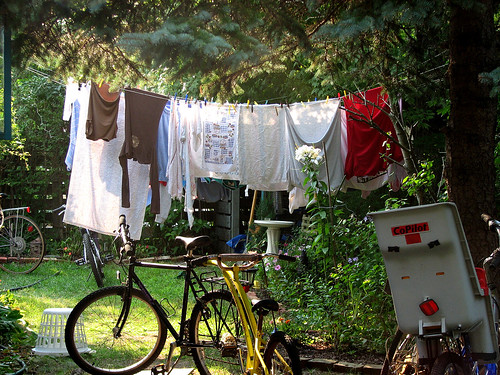
Alrighty, folks. Time for another monthly frugal Action Item. This month, in honor of springtime (in the northern hemisphere), it's back to frugal basics with a call to get yourself a solar laundry dryer. That's what we call a clothesline around here. Solar dryer sounds so fancy though, doesn't it?

Clotheslines have become contentious issues in the appearance obsessed US. This may be difficult for some overseas visitors to believe, but we have numerous homeowners associations over here that forbid the hanging of laundry on clotheslines, or even draping towels over balcony railings. Essentially this boils down to snobbery; the assumption being that only poor people would willingly hang their laundry up to dry outside, rather than use an expensive to buy and expensive to operate dryer. And who wants their largest investment associated, by proximity, with poor people? Needless to say, I despise HOA's that discourage any practice so harmless, so frugal, and so responsible in the use of non-renewable and polluting energy. (Most electrical generation in the US comes from coal. Hardly a green energy.)

Nonetheless, I know some readers have to deal with such monumental stupidity from a HOA. Others don't have any property on which to install an outdoor clothesline. I myself don't have one outside either. So I'm going to talk about ways of air drying your clothes without going outside. By all means, if you have the space and you want one, get yourself an outdoor line. But also consider the advantages of an indoor system. To list a few:
  • Save money year-round.
  • No need to carry a heavy basket of clothes anywhere.
  • Clothes don't get coated with allergenic yellow dust during pollen season.
  • Sub-freezing weather or precipitation won't make any difference to the laundry routine.
I've already blogged about my indoor clothes drying routine. I like to be able to hang up my laundry inside, right where I washed it in the first place. That way I notice any stains that might have made it through the first wash, treat them, and add them to the next load of laundry immediately. Here's a great post by one of my co-authors over at the Simple, Green, Frugal Co-op, detailing her fantastic and homemade clothesline in her basement.

If space is tight, there are still ways to hang your laundry indoors. Some popular options include the collapsible folding wooden drying racks, or retractable clothes lines. If you go for the drying racks, I recommend getting at least two. A full sized load of laundry in my house will not fit on one rack. Retractable clothes lines can be discreetly installed in a shower stall, where clothes can hang over the tub, on hangers if need be to maximize the use of space.

Another trick I use is to hang my "smalls" with clothespins from the downward facing edge of rubber-coated wire shelving in my laundry room. The shelving is right over my laundry machines, but socks and underwear are short enough that they hang freely. This saves room on the drying rack and indoor clotheslines for larger items. If you've been wanting more storage space in your home, consider this added benefit if you go with this fairly cheap form of shelving.

You can buy ready made retractable clotheslines at the store. Or you can fire up your creative juices and come up with a hanging line on your own. Though I have retractable clotheslines, I find I never retract them. You may end up doing the same, so your homemade setup could be quite simple. Coming up with your own indoor clothesline is likely to be by far the most frugal option. Though wooden drying racks are great and will last for decades, they're still more expensive than some nylon rope and a few hooks to anchor the rope.

The Fine Print
I confess to using the dryer for almost every load of laundry I do. But wait! Before you write me off as a hypocrite, I don't use it to dry the clothes, only to soften them up once they are dry (avoiding the curse of the crunchy towel), and to remove a portion of cat hair. All that takes is five minutes on the unheated "air fluff" cycle. Hardly any energy used for that. And since all the clothes are dry by the time I put them in there, I can really overfill the dryer. So I usually batch two loads in the dryer at a time. Since dry clothes don't weigh much and I'm not asking the dryer to do much work at all, the machine doesn't break down.

Other considerations
If you live in a humid area, or if you do a lot of laundry, be mindful of the risks of adding more humidity to your home by drying indoors. Moisture is slow death for buildings, which is why bathrooms have ventilation fans. So open windows when you dry indoors, or when that doesn't make sense, consider aiming a low fan at your laundry. This will cost a little bit of electricity, but far less than a dryer. It will not only dry your clothes faster, but will disperse the humidity throughout a larger area, rather than allowing it to build up and cause damage over time. On the other hand, if you live in a very dry environment, hanging your laundry to dry inside may save you money in more ways than one. If you normally run a humidifier, hanging wet laundry inside may allow you to turn off that appliance.

If you truly live in a minuscule home, then even finding space to dry some of your laundry is better than nothing. If a few of your clothes hang from the shower curtain rod to dry, you won't need to run the dryer quite as long as you would otherwise. If you absolutely must use a dryer, be diligent about cleaning out the filters, exhaust system, and lint trap so that it works as efficiently as possible and to extend the life of the machine.


Advanced Action Item
Like last month, I'm not offering an alternative, but an additional challenge. I really believe that air drying or solar drying laundry is within the reach of most people. If solar or air drying your laundry is old news for you, consider whipping up a batch of homemade laundry detergent. Homemade laundry detergent is a fun and easy project for kids, because you get to make a cool looking gel. You can also play around with adding fragrance with aromatic herbs from your garden, or with essential oils that you purchase. You'll not only save money, but also save the energy of hauling home a heavy powder or liquid detergent, as well as spare the Pacific plastic gyre yet another new addition. Or try switching to vinegar for your fabric softening and static cling reduction needs. Just add some directly to the wash as you would a store-bought fabric softener. It's cheaper and much less toxic than most alternatives. And if you happen to have an apple tree, you could actually make your own vinegar from apple scraps, for free!


New to these monthly Frugal Action Items? Catch up with more here:
January: Compact Fluorescent Bulbs & Hot Water Pipe Insulation
February: Kitchen Competence
March: Rein In Entertainment Spending
April: Go Paper-less
June: Raise the Deductible on Your Auto Insurance
July: Stay Cool Without Touching that Thermostat
August: Repair It!
September: Insulate
October: Preventative Health Care
November: Frugal Holiday Wish List
December: Plan Next Year's Garden

Friday, April 3, 2009

April Action Item: Go Paper-less

This month's Action Item is all about paper. Disposable paper items abound in western culture. They are designed for obsolescence. Sometimes their utility life from first use to disposal is mere seconds long. I want to challenge you this month to see paper products, especially those you pay for outright, in a new way. When you go to the supermarket and look at paper towels, toilet paper, paper plates and cups, and even "feminine hygiene products," you are looking at landfill. In other words, you're about to spend your hard earned money on garbage-to-be. Think about it: paper plate lying on the ground in a park - garbage; paper plate stacked up with other paper plates on the grocery store shelf - something you pay good money for. Does that make any sense to you? This is definitely one of those areas where frugality and ecological ethics match up very closely.

Sometimes we don't pay for paper explicitly. We get the paper for "free" with our purchase of coffee, fast food, or other convenience items. Needless to say, this is no bargain. Not only is the paper being consumed in a ridiculously frivolous fashion, but along the way you're paying a huge premium for the convenience of having food prepared for you, rather than making it at home.

Yet another form of paper consumption that I'm targeting for removal this month is junk mail, catalogs, and newspaper or magazine subscriptions. I've blogged before about all the good reasons for getting off catalog mailing lists. If you're trying to trim the budget (and these days, who isn't?), you don't need temptation delivered to your door on a daily basis.

So without further ado, here are several ways to cut the paper out of your life and save some money in the process.

Newspaper - you're reading this online. Get your news online too or off the radio. Cancel your subscription and ask for a refund of the balance. If you use the coupons that come with the Sunday paper, see if a non-frugal friend or family member will save the coupon section for you. If you can't make that happen, at least cut your subscription back to just a Sunday delivery if possible.

Magazines - Do you really read the magazines that you subscribe to? If you do, and you learn something from them, great. See if there's anyone in your area who also reads the same magazine who might like to split a subscription. You'll save both money and paper. Even better, cancel the subscription and get the magazine from the library. Unless you're subscribing to a magazine that is so packed with useful information that you're certain to refer to it again and again, it's worth asking yourself if you really need to pay for a personal copy.

Napkins - I hereby give you permission to actually buy new cloth napkins if you don't already have some. If you're going to do so, I recommend you steer clear of white or very pale napkins, which will show stains the best. If you have the choice, go for napkins with a small pattern on them; they'll hide stains very well over the years. Choose a sturdy flat woven cotton cloth with good stitching at the seams. I suggest you buy one for every member in the family you have or plan to have, plus at least two more for guests. If you have no cloth napkins, and your birthday is this month, this is the perfect gift to ask for. They'd make nice housewarming gifts too.

Paper towels - There aren't too many tasks that really ought to be done with disposable paper. Cleaning up cat puke or other unmentionables may qualify. But those should be rare events. Use cleaning rags to wipe up most spills and to perform most cleaning chores. You can replace paper towels for some uses with pages torn from old phone books. Phone book pages work great for cleaning glass. They'll work for soaking up grease from fried foods too.

Junk mail - There's no reason to put up with junk mail. There are plenty of unsubscribe lists you can find online. Fewer catalogs in your mailbox mean less covetousness, fewer temptations to spend, and less clutter in your life.

Paper plates - Again, is there really any need? Even if you want to go on a picnic, re-usable plastic plates, or the new re-usable Bambu plates fill in just fine for disposable paper. There are some plastic picnic plates that can even stand up to the dishwasher. If paper plates fill a need in your life, see if the re-usable lightweight plates could step into that role.

Paper cups - I can't conceive of any real need for these at home. Again, if you picnic or camp a lot, durable plastic cups will serve. Be disciplined about using your own mug at the office water cooler, or if you're still indulging in cafe drinks.

Tampons or Sanitary Napkins - I know not every woman is going to be swayed, but I am totally converted to the use of the diva cup. Over at the Simple, Green, Frugal Co-op where I occasionally post, Eilleen discussed the re-usable cloth menstrual pads she uses, in conjunction with the diva cup. There's no question at all that women pay a lot of money to menstruate in mainstream fashion. When I debated buying a diva cup, a quick calculation told me I'd break even after eight months of using the cup versus tampons. If you're smart enough to switch to a diva cup in your early years, you'll probably save more than $1000 by the time you hit menopause. That's not a trivial amount of money, especially considering that the money is just paying for landfill. If your first reaction is squeamishness, try giving it a second or third thought.

Note pads and scratch paper - Okay, even when you've gotten off as many of the junk mailing lists as possible, you'll still get some unwanted mailings and then a few legitimate pieces of mail. Use the envelopes for your grocery lists, notes to family members, etc. This is a much better choice than actually paying for a small note pad. And if you open up that junk mail and find paper that only has printing on one side, you can use the other side for scrap paper too. Obviously, pay attention to what information might be printed on the used side. You might not want to lose a shopping list that has your financial information printed on the back. So just shred that stuff and use the form letters for your to-do lists. If the paper isn't folded or the folds won't be an issue, you can also use blank sides of full-sized paper in your computer printer for drafts or informal use.

Paper shopping bags - C'mon. You know the drill here. Instead of facing that familiar ethical dilemma between deforestation (paper bags) or albatross chick and sea turtle mortality (plastic bags), let yourself off the hook already and make a habit of canvas or recycled plastic shopping bags. Keep a few in your trunk, or wherever you'll remember them. It's not that hard. And it's becoming commonplace enough that you won't be mistaken some granola-munching, patchouli-smelling, Birkenstock-wearing hippie these days (if that concerns you). If you're fortunate, the store you shop at is forward-thinking enough to give you a small bag credit for providing your own bag.


Advanced Action Item: There's really no alternative item this month. Instead we have a few items that are for frugality/sustainability adepts. If all of the above is old hat for you, then you've probably already considered these options. I freely admit that I'm not yet at the point of committing to cloth toilet wipes. Since I don't have kids, the diaper issue isn't one I have to contend with. (For the record, my own infant years were spent in cloth diapers.) If you are still in the process of having babies, or if kids are in your future, consider the many advantages of cloth diapers, not least of which is the monetary savings. Trent at The Simple Dollar wrote up a cost comparison between cloth and disposable diapers. His conclusion was that he wished he'd put his first child in cloth diapers rather than waiting for the birth of his second child to make the switch.


For those of you who have been following along with these Frugal Action Items since the beginning of the year, how's it going? Have you noticed the savings? Have your efforts made a difference in your budgets or savings goals? Please chime in via the comment section.

New to these monthly Action Items? Catch up with more here:

January: Compact Fluorescent Bulbs & Hot Water Pipe Insulation
February: Kitchen Competence
March: Rein In Entertainment Spending
May: Solar Dryer
June: Raise the Deductible on Your Auto Insurance
July: Stay Cool Without Touching that Thermostat
August: Repair It!
September: Insulate
October: Preventative Health Care
November: Frugal Holiday Wish List
December: Plan Next Year's Garden

Sunday, March 1, 2009

March Frugal Action Item: Rein In Entertainment Spending

Time for another Frugal Action Item. In January we started out with an easy once-and-done switch from standard to compact fluorescent bulbs. Not too taxing and no discipline required once you make the change. Last month's Item was a lot more challenging. I asked you to both acquire new kitchen skills and change dining out habits. In March I'm shooting for something in between in terms of how much effort you'll need to put out. You don't need to learn a new skill, but you will need to make some changes in your routine.

The Frugal Action Item for March is still going to be a tough sell for some folks, which is why I am encouraging you to look at this as a one-month experiment. So here it is: Just for this month, use your local library instead of buying any books, magazines, instead of paying for another month of Netflix, cable tv, or heaven forbid, actual movie theater tickets. I know, I know, I can hear the moans and protests already. That's why I want you to treat this as an experiment.

Put your Netflix or Blockbuster account on hold, put the next book you simply must have on a wishlist instead of on your credit card. Get thee to thine local library. Look over the dvds they have available for the borrowing - completely free! Remember that dvds are heavily borrowed, so what you see available at any given time is only a fraction of the library's holdings. This is doubly true on Fridays and Saturdays. Browse the bookshelves and learn how to use the library to your own advantage. Examine their computer system. Ask questions. Find out about the process for putting in a hold for popular movies that are checked out when you look for them. You probably won't need to wait too much longer than you do for hot titles from Netflix. Learn how your library handles inter-library loans or purchase requests. What your library doesn't have in its own collection, it can probably borrow - just for you - from hundreds of other libraries. A little patience may save you a small bundle of cash.

If you miss the big screen experience, well, make your night at home with the movies special. Make yourself a killer bowl of popcorn, and cozy up with a loved one for some frugal together time.

I'm asking you to give this challenge a fair shake. You can always go back to your usual routine after a trial month if you and your family totally hate it. But pursue the experiment at least that long before you make up your mind. A lot of times we dismiss a change that makes sense because it means a disruption of our routine. Yes, getting to the library once a week may be new to us. But it may also easily save us $20 or more each month, and become something that we look forward to, if we only give it a chance. Consider the differences in the library experience versus the movie theater or bookshop experience. Is paying for a novel and having it around the house really so much better than reading it once and returning it to the library? Is taking in a flick at the theater with a whale sized portion of stale popcorn really worth $12, as opposed to watching a movie in your pjs at home? Your tax dollars are paying to support your local library, so you may as well benefit from it.

Alternative Action Item: If you don't have cable, a Netflix account, or you live so remotely that it's a 45-minute drive to the library in a direction you rarely go, I instead challenge you to have friends or family over for a cheap entertainment night of board game or card playing. If there are kids involved, give them an age-appropriate jigsaw puzzle to work on.


New to these monthly Action Items? Catch up with more here:

January: Compact Fluorescent Bulbs & Hot Water Pipe Insulation
February: Kitchen Competence
April: Go Paper-less
May: Solar Dryer
June: Raise the Deductible on Your Auto Insurance
July: Stay Cool Without Touching that Thermostat
August: Repair It!
September: Insulate
October: Preventative Health Care
November: Frugal Holiday Wish List
December: Plan Next Year's Garden

Monday, February 2, 2009

February Frugal Action Item: Kitchen Competence

Time for another month's Frugal Action Item. This month, in honor of the chilly winter weather we're having in the northern hemisphere, I am challenging my readers to improve their kitchen skills. My goal with these Action Items is to provide concrete steps that both renters and homeowners can take to improve their household budgets. By the same token, this month's item highlights areas for skill expansion for all but the most serious professional cooks and homesteaders.

If you already know how to cook well, congratulations. Now skip down to the Alternative Action Items below. If you don't know how to cook well, you've most likely been using this as a ready-made excuse for eating out, or picking up ready-to-eat meals at the grocery store. Both of these practices are a serious drain on your food budget, and they also tend to steer eaters to less healthy food choices. Additionally, highly processed and over packaged foods contribute significantly to the production of greenhouse gasses, and thus global climate change.

So this month, I urge you to check out a few basic cookbooks from the library. The goal here is not to wow anybody with fancy meals or exotic ingredients. Instead, look for a few dishes that can provide a basic but healthy meal in a single item. Candidates include casseroles, twice-baked potatoes, soups, pasta dishes, fritattas, and so on. None of these dishes are difficult to prepare, and they can all be made to include green vegetables. Challenge yourself to prepare at least one such dish each week. Keep an eye out especially for dishes that use plenty of vegetables, or meat dishes that are readily supplemented by vegetables or starches. Don't be afraid to add extra vegetables to a dish with meat. These types of dishes will help you stretch your food budget farther.

If you are really new to cooking, I recommend that you begin with pasta dishes and soup. A good way to build skills is to start slow and plan to repeat dishes with some variation. For instance, this week you might begin with a pasta and tomato sauce dish. In the second week of February, make a broth-based soup. In the third week, you could prepare a pasta with an olive oil sauce. And in the final week of this month, prepare a chowder soup of some kind. So two types of pasta and two different soups in a month.

Recommended cookbooks for beginning cooks:
The New Best Recipe, by the Editors of Cook's Illustrated
How to Cook Everything Vegetarian, by Mark Bittman
Joy of Cooking, by Irma S. Rombauer
The Fannie Farmer Cookbook, by Marion Cunningham

I can specifically recommend the following dishes from these cookbooks. They're all delicious and easy to prepare:

Chicken with Dumplings, from The Fannie Farmer Cookbook
Cabbage Stuffed with Lentils and Rice, from How to Cook Everything Vegetarian
Twice-Baked Potatoes, from The New Best Recipe
Pulled Pork, from The Joy of Cooking

If you want to try a simple meal of roasted chicken, have a look at my walkthrough of this dish at the Simple Green Frugal Co-op.

My hope is that the joy of mucking about in your own kitchen will prove addictive enough that you become an instant convert. But I recognize that not everyone enjoys cooking as much as I do, and that learning to cook may be a daunting enterprise to some. So I will allow as how the monetary savings would likely also be a powerful motivator. Or, you might find inspiration in the knowledge that you are preparing wholesome food for yourself and your family, thus contributing to better health. Perhaps parents could also show children that developing new life skills can happen at any age. In the end, there are many reasons to improve our kitchen skills.


Alternative Action Items: Accomplished home cooks are hereby challenged to learn how to bake bread, and to bake at least one loaf each week of this month. It's a good time of year to bake; you'll be warming your house up at the same time. See below for some basic resources.

If you already know how to bake bread, then I would suggest learning some form of food preservation, such as canning, fermenting, homebrewing, cheese or yogurt making, or dehydrating. (Heather had a great post on easy-peasy jelly making just a few days ago.) I include this suggestion only for those who are already quite advanced in their food preparation skill set. Canning, fermenting, cheesemaking, brewing, and dehydrating will all required you to invest in some fairly specialized equipment, and that's not an investment I think everyone should make...yet. But if you have all the cooking and baking skills you really need, it's certainly something to think about. If you're at that point, you probably don't need any advice from me, which is just as well since I'm far from an expert in all of those subjects. We're still working on canning and homebrewing.

If you already bake and preserve food routinely, your challenge for the month is to pass on some of your impressive kitchen skills to a young person. Equipping the next generation with basic skills for their own self-sufficiency is a noble task and a generous gift of knowledge and self confidence.

Suggested resources for baking skills:

Breadtopia.com - This site has fantastic tutorials on my favorite easy method of bread baking: no knead. Try this method! It's easier than you imagine and the bread is fantastic!

The Bread Baker's Apprentice, by Peter Reinhart - Highly detailed book on the fundamentals of bread baking, fabulous recipes too.


I want to hear your reports on this month's Frugal Action Item! Please leave a comment and share stories of your efforts. We're all in this together, so let's support each other.


Other Monthly Action Items:
January: CF Bulbs & Pipe Insulation
March: Rein in Entertainment Spending
April: Go Paper-less
May: Solar Dryer
June: Raise the Deductible on Your Auto Insurance
July: Stay Cool Without Touching that Thermostat
August: Repair It!
September: Insulate
October: Preventative Health Care
November: Frugal Holiday Wish List
December: Plan Next Year's Garden