Friday, April 30, 2010

Rerun: Late Frost and Tender Seedlings

I ran this post last year, just after a late frost in the middle of May. It occurs to me that running it a bit earlier this year might prevent some over-eager gardeners out there from planting too early and risking damage to their tomatoes and other heat-loving plants.


Here I am gardening in hardiness zone 6B. Depending on whom you believe, our average last frost date is either May 5th or May 10th. It's May 19th and there's frost on the grass outside as I type this. I watched my neighbor cover up his tomato seedlings yesterday evening, as I brought my tender heat-loving seedlings indoors for the night. I'm not going to gloat. I hope his seedlings made it. He built some beautiful wooden trellises this year to support his plants. But I am going to take this opportunity to throw my own piece of two-bit advice into the marketplace of gardening ideas.

Don't plant your tomatoes as soon as your last frost date has passed. Don't even plant at a certain amount of time after that date. I'm not saying this simply because of the chance that a late frost could surprise you. The thing I watch for is the day when I can be reasonably certain that overnight temperatures will no longer fall below 50 F (10 C). I know this will come at least a week or two after our average last frost date, and possibly three weeks later or more. I watch the five-day weather forecast, and I won't plant until I see five solid days of overnight temps above 50 degrees. If the predicted overnight low a few days out is exactly 50, I wait. If I see an overnight temperature of 51 or 52, I might plant with a row cover. But mostly I wait.

Why do I use this temperature as a guideline? Because tomatoes are essentially tropical plants. Yes, they've been bred to survive in our northern climes. They'll live through 40 degree nights. But they won't thrive. In my experience, any tomato fruit which has ever been exposed to temperatures below 50 degrees will never develop a good tomato flavor. Even if that fruit is a tiny green bud that has just shed its blossom. And what are we growing our own tomatoes for if not for superb, better-than-candy flavor? Tomatoes need heat and are completely allergic to cold, especially at the beginning of the season. Other gardeners get earlier tomatoes than I do. But the fruits aren't worth a damn, in my opinion.

Even my earliest fruits don't compare to those that mature during the three golden weeks of August. Those fruits probably never know temperatures below 60 or even 65 F. Now those are tomatoes worth eating. They're also worth waiting for. That flavor is the reason why I gave up buying fresh tomatoes at the grocery store, no matter what it says on the sign. "Vine-ripened," "hothouse," - whatever; I don't care. Once you've tasted a real tomato, you won't see the point of eating those red globs of cardboard that are offered for sale 52 weeks out of the year.

All of this goes doubly for pepper plants. They are even more heat-loving than tomatoes. As a rule of thumb, I aim to have my tomatoes in the ground on June 1st, and my peppers in the ground in mid- to late June. That's what works for me in my area anyway. Just don't let your tomato or pepper seedlings get rootbound as you are waiting for the temperature to cooperate. Repot them in larger containers if you need to. Rootbound plants seldom recover to do well in the ground.

I'm sure that seasoned gardeners have their own habits and preferences based on long experience, and I don't intend to start any argument. Direct experience is the best teacher, and it should not be lightly set aside on any authority. My recommendation is offered however to novice gardeners, and I understand that there are many people taking up gardening for the first time this year, due to our lousy economy. It's very easy to get discouraged when our first attempts at any new enterprise fail. So if you're new to gardening, don't necessarily follow what your neighbors are doing. Gardeners can be notoriously optimistic about frosts and planting dates. Everyone is dieing to get that first homegrown tomato. You may do better to wait it out with your heat-loving plants.

Gardening can be an extremely frugal hobby. But it's only frugal if you manage to keep your plants reasonably happy and productive. Losing plants you've grown from seed is absolutely heartbreaking. So take rules of thumb about planting dates with a grain of salt, and beware those late frosts!

Wednesday, April 28, 2010

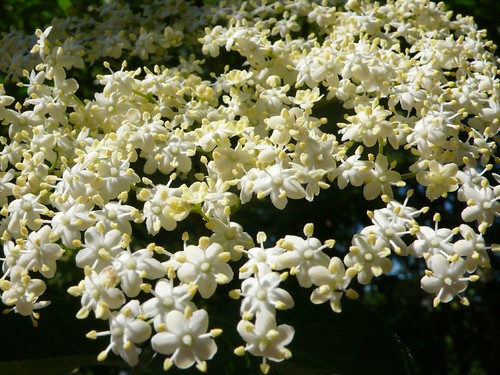
More Elderberries

Originally uploaded by Smoobs

We put in two elderberry plants last year as a productive replacement for a long patch of forsythia.  The forsythia had the added benefit of providing a screen for a not terribly attractive lot next door, but the elderberries will do that too once they've grown for a few more years.  We've just added a couple more this year.

Elderberries produce best when they have another variety with which to cross-pollinate.  Sadly, one of the two plants we purchased last year looks to have died, but come back from the rootstock.  This meant we had two plants, but only one of a known variety.  We decided to let the rootstock live, but to add one plant of a variety we know to differ from last year's variety that lived.  So we got a 'goodbarn' elderberry from Fedco this year to go with the 'Johns' that clearly survived from last year.  But we still have space for one or two more elderberries.  So when farming friend offered to let us dig up some of the wild elderberries on her property, we decided to take her up on it.

On Saturday we got two of her wild elderberries.  Her husband informed us that the fruits of these wild plants are very small; about the size of BB gun pellets.  If I only had such wild fruits to look forward to, that would be rather discouraging.  However, I was delighted.  Because you see, the fruits are not the only thing worth harvesting from an elderberry plant.  The blossoms themselves are renowned for their delicate flavor and aroma.  I've had elderflower syrups and essences that have blown my mind.  And heard tales of elderflower fritters made by batter-frying entire clusters of blossoms.  I've also heard of the blooms being used, either during brewing or as an infusion after the fact, to flavor all sorts of alcoholic beverages: champagne, mead, wine, vodka, etc.

I'm definitely interested in taking some elderflower blooms to experiment with, when our plants come into production.  But cutting the flowers will mean less fruit.  With the wild elderberries though, the fruit will be no great loss.  I can leave just a few blooms to cross-pollinate with the better fruit producing varieties.  The rest of the blooms can be used for other things.

Elderberries don't seem to grow much in their first year after planting.  Most likely, they concentrate on root development.  Like many berry bushes, it tolerates some shade, but produces better with at least 6 hours of full sun per day.  They can eventually reach 6 meters in height, though size at maturity varies by the cultivar.  Last year's plantings are already showing vigorous growth this year.  I'm not sure when we'll get our first harvest of either blooms or berries.  But I'd be surprised if we didn't get at least a little sample by next year at the latest.  I'm really looking forward to it.

Aside from the culinary merits of the flowers or berries, elderberry plants have other uses as well.  Sambucus canadensis is one of those "medicine chest" plants.  Soothing ointments and eyewashes can be prepared from its leaves and flowers.  All parts of the plant have been used for various complaints over the years.  Cuttings of elderberry are good for activating a compost pile.  The leaves can be rubbed on skin as an insect repellent.  All around, it's a very promising plant that I'm happy to have as part of our edible and useful landscape.

Wednesday, April 21, 2010

It's Getting to be a Real Saga

I updated you a little too soon on the bees.  It's been one thing after the other with my beekeeping debut.  I left the house for a few hours yesterday and returned home to my husband's account of the Russian bees swarming over the garden, dispersing wildly and then all roaring back home twenty minutes later.  I missed it.  We were both mystified, considering how much work the bees were putting into building comb and collecting pollen.  This morning early I opened up Izhevsk to see what I can see.  The short answer was not much.  There was pollen in some cells.  I didn't see the queen or any eggs, but the colony had more gorgeous white comb than the last time I checked and still seemed active and numerous.  I figured I just missed the queen and that any eggs or brood were obscured by the bees thickly covering the comb, which could have been because they were trying to keep brood warm on a chill morning.

I worked in the garden today until early afternoon.  I decided to wind up my outdoor work with a little beehive viewing, just as it was clouding up before a predicted rainstorm.  That's when I saw the cluster of bees on the grass, about 20 feet straight out from the hive.  Sure enough, there was a bee with a white dot on her thorax: the queen.  Rain was now immanent.  I set the lawn chair over the little cluster of bees to keep them dry, then rushed inside to get help from my husband and to jump into my bee suit as fast as ever I could.  We grabbed our bee tool bucket and got the smoker going as quickly as possible.  By the time we got back to the bees, the rain was beginning.

We whiffed a few puffs of smoke at the hive, and at the bees on the ground, as fat rain drops came down.  Then as quickly but as gently as I could, I brushed some of the bees into a plastic planter, rushed over to the hive just as my husband opened it, and dumped the bees in.  I'm pretty sure I got the queen, but not 100%.  And there's a chance I might have injured her as I tried to return her to the hive.  Then there's the likelihood that she was out on the grass overnight with a small group of bees.  Who knows?  I could only try to do my best in a dicey situation.

When the rain let up a short time later, I took a look around the hive and didn't see any clusters of bees, so the queen may well be in the hive.  The rain probably would have been the end of her, or at least tonight's low temperature would have been the end of a group of wet bees.  If our frantic efforts work to restore a functioning queen to her hive, and if the Russians don't swarm out again on the next sunny day (Tomorrow?  Friday?), it'll be a miracle.

I'm having a rough start to this beekeeping thing.  It's going to get easier than this, right?

Tuesday, April 20, 2010

Bees Update


I got lucky and was able to replace the Italian bees that took off last Thursday.  It's good to be in contact with the local beekeeper's club.  I went to the monthly meeting the same day I discovered my bees had gone and pressed the flesh, did my pitiful but earnest new beekeeper routine, and begged for leads to packages or nucs.  On Saturday I got an email about a beekeeper who had some customers back out of an agreed upon sale of nucs.  They were Italian bees with new queens, and only about an hour away.  We were there Sunday afternoon to pick up our new bees.

Foligno (my Italian hive, nearer one in the picture above) looks a bit different now, since the colony was sold in a medium super with a full complement of comb and some brood.  We kept them in the garage overnight since it was going to be so cold.  We wanted to give the smaller colony a break with keeping their brood warm enough to survive.  It was a snap to "install" them Monday morning and top off their feeder.  They did their orientation flights as soon as it warmed up.  That's what bees do when you move them: they map the world by flying out of the hive and turning to look back at their home, gradually flying farther and farther away as they familiarize themselves with the landscape.  By Monday evening, we saw foragers returning to the hive with their pollen baskets nice and full.

While we were suited up, we checked on Izhevsk, the Russian colony we started this year as well.  They look great, even if they are drawing comb directly inside the frame feeder.  We didn't see the queen, or take out more than one frame, but there is a good deal of comb being drawn and we saw some pollen stored there.  It's a very active colony that looks promising.

I found it interesting that both Izhevsk and (the original) Foligno kicked a bunch of drones out just after the packages were installed.  Drones, the male bees, are total freeloaders.  They contribute nothing whatsoever to their home colony.  A newly installed package of bees has plenty room but no time or energy to spare.  Drones won't even help themselves to food within the hive; they beg food from the (female) workers.  Looks like when push comes to shove, it's the drones that get the boot.  There were many of them dead in front of the hive in the first few days after installation.  I can only speculate, but it seems there's a lesson in there somewhere.

For the record, the trick of painting cinder blocks with used motor oil to keep black ants away doesn't work.  Maybe a full on dunking or soaking would be more effective, but the thin coating of oil we put on the blocks has almost disappeared from the top course.  I think the oil is redistributing itself within the material of the block.  I found a few ants on each of the hives yesterday.  I do think the oil is effective to limit wicking of moisture from the ground though.

Friday, April 16, 2010

Bad News - Good News

The Italian bees have gone.  They were clustering on the bottom of their screened bottom board early yesterday morning when I went to tend the hens, and gone by lunchtime. The queen had made her way out of her cage and they had even started to build some comb.  But there were only a few confused and sad looking bees wandering helplessly around the inside of the hive when I checked on them.  Of course I'm disappointed that they chose to leave.  But I wish them well in the world and hope they make it out there.  I attended the local beekeepers' meeting last night, told my sad tale, and begged for any leads on a replacement package.  The experienced beekeepers found my story very odd, and packages are in very short supply.  I may have to try to catch a swarm if I want two colonies, or settle for just one.

On a more positive note, the Russians are doing great.  They have a significant start on their comb building, and very little burr comb (that's "non-regulation" comb - comb built where a beekeeper doesn't want it).  It looks like Izhevsk will be a strong colony.

Another positive note is that I got a bunch of ramps for transplanting.  The few I put in two years ago are still alive, but their numbers don't seem to have changed at all, so I still don't feel I can harvest any.  I'm going to put these new ramps in several locations and see where they do best.  If I manage to make them happy enough to propagate well, ramps could help bridge the garlic gap, which we're facing right now.  No more fully formed garlic from the garden until late June at the earliest. 

Tuesday, April 13, 2010

Self-Sufficiency: How Far Have We Come?

It's been a few years since I started down the road to self-sufficiency, and started checking out of the pervasive corporate-culture that dominates the average US lifestyle.  It's a road I never expect to reach the end of, because I know that complete self-sufficiency is not really possible.  I don't see this as a negative thing.  There are endless shades and degrees of self-sufficiency, and building real community is the other side of the self-sufficiency coin.  Today I want to talk about a few key areas where we have - seemingly - achieved self-sufficiency, and explore the reality in those cases.

Garlic - This is one product in which we come very, very close to genuine self-sufficiency.  I bought garlic seed stock in 2007 and have not paid for any more since then.  Garlic grows well in our area, and I managed to salvage a decent crop, including viable seed stock even during our incredibly wet year of 2009.  Potentially, I could go on indefinitely saving seed from each year's harvest, with no need to purchase garlic ever again.  The fly in the ointment has been that so far I have not really managed to keep us in fresh garlic 12 months out of the year.  I'm working on bridging the garlic gap with green garlic, garlic chives, and garlic scapes.  And we can use the garlic I dehydrate when the last of the harvest begins to go off, though that requires electricity we don't generate ourselves.  It's fair to say that garlic is a core product in our lives.  We eat a lot of it; I don't really know how to cook without it; and we deeply resent having to pay for it.  So self-sufficiency in this food would mean a lot to us.  I'd say that we're 70-80% of the way there, and there's a good chance that we can narrow that gap further.

Eggs - On the face of it, we're self-sufficient in eggs.  With a backyard flock of just four layers, we have more than all the eggs we can eat.  But the devil is in the details.  We buy most of the feed for the girls.  True, it's milled locally, so potentially we could continue to obtain that input even if TSHTF.  It's a long drive though.  And the thornier issue is that we don't keep a rooster.  Even if we did, our girls are production birds, with all the broodiness selected out of their ancestors.  Laying hens are very productive for a good two to three years, but then their output tapers off.  With no chicks from our flock, we'll need to buy more birds.  I've taken several steps to supply more of the girls' feed from our own resources, and it's my plan to increase these efforts this year and next.  Less-than-prime garden produce, our kitchen scraps, weeds, Japanese beetles, and acorns are all part of the girls' diet, free for the taking from our own 2/3 acre homestead.  But if I'm honest I have to say these all add up to less than half of what the girls need to lay productively.  And without the ability to produce a new generation of hens, we'll never be truly self-sufficient in eggs.  I'd say that we're only about 40% self-sufficient in eggs, despite the fact that we never buy them.

Potatoes - We now grow all the potatoes that we eat.  When we don't have potatoes from our own harvest, we eat other things.  Although it's potentially possible to save seed from one harvest to begin the next year's planting, there are significant limitations to that practice.  The major obstacles are late blight and, to a lesser extent, viruses that can carry over from one year into the next in the seed potato.  Late blight can destroy a crop of potatoes outright, while the viruses can damage a lineage of potatoes progressively over time, so that yields slowly dwindle year by year.  It's certainly possible to save a few potatoes for seed from one year to the next. I've done that.  But since we had late blight last year, none of our potatoes can be used for seed this year, and any potato plants that crop up in the garden will need to be destroyed.  Late blight makes the whole prospect of self-sufficiency in potatoes kinda dodgy.  We could go for years without another outbreak.  We could decide to grow only blight resistant varieties, and take our chances with saving seed even in years we know the blight was prevalent.  So far, we haven't done that.  I've bought seed potatoes every year.  Even if blight were taken out of the picture, there are the less obvious viruses that simply reduce yield over time.  Given these challenges to genuine self-sufficiency with this crop, I'd say we're only 50% self-sufficient in potatoes.  Our prospects for achieving real self-sufficiency over the long term seem low here.

Bread - I can't say that I never, ever buy bread.  There's a special loaf made by a local baker who turns up at my farming friend's monthly on-farm markets over the winter months.  I buy some of her bread from time to time.  But that's about it.  All the other bread we eat is made by me, and my baking skills are good enough that we would turn our noses up at the sort of bread supermarkets in our area sell.  However, we don't grow wheat, nor even grind our own flour.  It's all bought in bulk.  Even if I wanted to grow our own wheat, the high-protein "hard" wheat needed for producing good bread does not grow in my region; it requires an entirely different climate.  And even if that weren't an issue, we don't have near enough space to grow the amount of wheat we go through in a year.  It's true I bake some breads that do not require hard wheat, and potentially those could be made from wheat grown nearby.  In other words, we're a long, long way from self-sufficiency with bread.  The little bread we buy is hardly an issue.  We could give that up without any hardship at all.  I also know how to begin and keep a sourdough starter, and have done so in the past.  So if I couldn't buy yeast, it wouldn't be the end of bread for us.  We even have a rarely used manual grain mill, meaning we could grind our own flour if we had the grain. But we will likely always be dependent on purchased flour or at least purchased grain.  And then there's the whole issue of how the bread gets baked.  Right now we use an electric oven tied to the grid.  We generate no electricity of our own, and even if we did, running an electric oven is extremely costly in terms of energy consumed.  Potentially we could build a wood-fired outdoor oven, and that's certainly feasible for the long term.  Right now I'd say we're only 25% self-sufficient in bread, despite the fact that I bake virtually all we eat.  Having that outdoor oven might add 10-20% efficiency, and a sourdough starter maybe another 5-10%, in my estimation.

Fruits and Other Vegetables - It's hard to be precise about this, but I think it's fair to say that we grow more than 50% of all the fruits and vegetables we eat.  There's room for improvement, certainly, and we're working on that.  Some of the perennial plants we put in over the last few years are nowhere near their maximum productivity.  In fact some have yet to produce at all.  We don't need to do much else but prune and tend them for those plants to displace purchased food in future years.  So at this point we can "coast" to a greater degree of self-sufficiency in fresh fruit and veg over the next few years.  A good portion of the fresh produce we still do buy comes from local producers, especially fruit in season and greenhouse salad greens over the winter.  But I still buy a lot of onions, herbs during winter time, and the occasional citrus fruit or avocado at the grocery store.  We now have both a lemon and lime tree, though neither has produced a crop yet.  We have mostly weaned ourselves off fruits and vegetables that just don't grow in our area.  Bananas were dropped without fanfare some time ago, and avocados are treated like the treats they are.  At this point I think we've done most of the work we can do, both on our mental/dietary habits and the infrastructure needed to be really self-sufficient in produce.  There are two concerns over the long-term. Seeds and rootstock.  I need to learn more about saving seed and then put it into practice.  And learning to graft scion wood onto rootstock would mean more real self-sufficiency over the long haul.  The second concern is that right now we have the luxury of supplementing what we grow with lots of purchased carbohydrates, meat, and dairy.  In the future our diet might have to rely more heavily on the fruits and vegetables we can grow here.  What counts for 30% of our diet right now might have to be 50% or more of our diet in the future. I'll give us 50% self-sufficiency in fresh produce, with an additional 20-30% already in the pipeline.  The remaining 20-30% could be covered by a combination of buying from local growers, a few more of our own cold frames, and more skill development on my part.

Heat/energy - We are in the (agonizingly slow) process of having a passive solar thermal heating system installed for our home.  This will make us independent of oil so far as heating goes, and it may at some point give us hot water out of the tap.  We don't live in the harshest area of the US so far as winters go, but getting through a Pennsylvania winter without heat would be no joke at all.  Our zone 6b means the average low wintertime temperature is -5 F, or -21C.  We heat our house intermittently from as early as mid-October through mid-December, steadily from at least mid-December through mid-March, and again intermittently from mid-March through at least late April and possibly into May.  And our thermostat is never set above 64 F/18 C.  So really, there are only about five or six months out of the year when lack of heating would be no big deal for us.  Despite the fact that our heat will now be generated "for free," (and the cost of the passive solar system is nothing to sneeze at) we're still completely dependent on the electrical grid.  If we lost power, we'd also lose our heat when the pumps no longer moved warm water through our radiant floors.  Can we remedy this?  Possibly.  We're weighing the decision to install PV panels that would supply enough power to run the systems we consider really critical to our lives.  Having enough electricity from a grid-independent system to keep the chest freezer and a few pumps running would make me feel pretty secure.  Enough homegrown power to run some lights and our computers would be gravy.  This is entirely possible - in theory - but the expense would be significant.  Right now I'd say we'll be 40% self-sufficient with heating.  We've already done plenty of work to improve the energy efficiency of our home.  So most of the remaining 60% could only be achieved if we were to shell out for a PV system.  Then of course, in the long-term there's the thorny issue of replacing components of either the passive solar or PV systems in a low-energy world.

I could probably carry on further with this sort of evaluation of my life, but I'm sure you get it, and it's probably already gotten a bit tedious.  My intention was to explore the real issues of a self-sufficient lifestyle, and to encourage you, dear reader, to think about what challenges you might face on the road to self-sufficiency.  So what about you?  I know the challenges and resources differ enormously among the readership here.  I think it would add a lot to the discussion if you posted about this topic on your own blog, or if you add a comment to this post.  I'd be especially interested to see anyone report on other areas they've tackled, such as health care, education, transportation, dairy, etc.  Let me know if you do post something along these lines on your blog, and I'll be happy to add a link here.  Some general issues you might want to wrestle with:
  • How much does our own skill/labor "count" for in terms of self-sufficiency if we must purchase inputs?
  • How do you factor in dependence on a locally produced good versus dependence on something produced very far from where you live?  Are we more self-sufficient if we can get something from our neighbor, or make a bicycle trip to obtain something locally produced?  Why, or why not?
  • If you depend upon "infrastructure" (e.g. fruit trees, livestock, PV panels, etc.) that you own, but that will eventually die or wear out, how do you gauge your level of self-sufficiency?