Monday, November 14, 2011

A Nice Barter Arrangement

With the beginning of cold weather, I've been reaching for canning jars of homemade chicken stock a lot lately.  So much so that I'm completely out, not only of chicken stock, but of any stock whatsoever.  I don't like being without this building block of good soup, which is so fortifying at this time of year.  I have a few carcasses from roasted chickens saved in our freezer, but I know they're not going to make as much stock as I'd like to be putting up right now.  Buying commercial stock, even the organic brand that I used to buy, just isn't on my radar these days.  As anyone who's made their own knows, store-bought stock just doesn't hold a candle to homemade.

So I started looking through the market lists of the grass-based farms in my area.  Even though I'm fully aware of how much work goes into raising healthy, ethical food, I'm still often initially surprised by the prices of animal products from these businesses.  My next thoughts are always the same: the prices are fair, given what I know about labor and materials costs for this type of production, and given the methods they employ which show a proper respect for the environment; and to boot, none of these farmers are getting rich on the prices they're charging for the foods they offer.  Still, when I saw the price of the chicken backs and bones from other animals that I would need for making stock, I decided to try a different tack.

I asked my Farming Friend whether she might be interested in bartering finished stock for the bones to make it, a 50-50 split.  I know she likes to cook with stock, but she's a very busy woman, and I figured she wouldn't mind having someone else do the work.  As it turned out, the offer was especially attractive to her, because she doesn't have time to do the canning.  She has typically frozen her stock, but that ends up using too much of her freezer space, which is at a premium for the meats that she sells.  So I told her I'd be happy to make and can as much stock as she has bones for over the winter months.  It's a win for me because I get free bones and I can do this work when the demands of the garden and livestock are minimal.  As a bonus, the heat generated by the roasting, simmering, and canning processes will be most welcome in the house at this time of year.  She has agreed to return the canning jars and the re-usable lids and rings that I use.  And she'll send lamb and goat bones my way any time she has them on the same barter basis.

I'm always so tickled when things like this work out - a benefit for both parties.  I trust her to produce good, clean food.  She trusts me produce tasty and safely canned stock.  I call that win-win any day, and I'd like there to be more bartering in my life.  It's something I sometimes feel shy about proposing to people, even though no one has ever seemed offended by the idea of barter. 

I'd be curious to hear about any barter arrangements you have.  If you barter, were you the one to propose the exchange?  Have you ever been turned down on an offer to barter?  Any tips on how to successfully arrange bartering agreements?

Tuesday, November 1, 2011

Back in the Loving Arms of the Grid


The freak Halloween storm that visited the northeastern US left us without power for most of the weekend and Monday.  On Saturday we watched as heavy flakes of snow fell, and kept falling all day.  This came just two days after the first light frost of the year, which came more than three weeks later than the historical average first frost date.  We hadn't even had a hard frost yet in this incredibly mild autumn season.  That meant that most of the trees were still fully garbed in their own leaves.  And that meant a large snowfall was a big problem.

On Saturday afternoon we went around outside trying to keep the worst of the snow off our fruit trees, young and old, and also off the plastic sheeting of the still unfinished hoop house.  This was accomplished with brooms and poles.  That went well; we had no damage to those trees or the little hoop house.  But the taller trees were much harder to protect, especially the very large shade trees close to the house.  All through the afternoon we could hear trees and tree limbs all around the neighborhood snapping and cracking; it was like a pan of popcorn popping, so frequent and regular were the sounds.  By noon we had lost power, and the phone went dead a couple hours later.  Outside we watched the occasional flash of electrical transformers exploding, waiting just a moment for the sound to reach us.  The audio-visual show continued well into the evening as the snow continued to fall.  After each nearby crack! I checked in anxiously with my husband to make sure he hadn't been hurt by a limb coming down.


I have to admit that even though we had advanced warning of this storm and its likely consequences, I prepared less well than I did for the hurricanes of August and September.  We skated through those storms with barely a blip.  Not so much this time.  I did make sure the dishes were done and that we had water on hand to flush toilets and for drinking.  I showered on Friday night and even filled our large thermos with hot water so we could wash our faces.  But I didn't gather our oil lamps, matches, and flashlights, and didn't fill the empty space in the chest freezer with bottles of water to move to our refrigerator.  Now we keep plenty of stored water on hand all the time anyway, and we did have everything we needed to weather such a storm and power loss.  The large chest cooler got cleaned on Sunday, loaded up with plenty of snow, and placed on the porch to accept the contents of our fridge and house freezer.  We had heat from the gas fireplace insert that I had carefully laid away batteries for in case of power loss; we had our gas stovetop range to cook on; and we were well supplied with tanks of propane to keep those going for quite a while.  All in all we were fine.  But I still felt as though I'd been caught flat-footed.

The funny thing is that just Saturday, after listening to Nicole Foss's description of how she prepared her family for life after peak oil, I had talked with my husband about getting some deep cycle marine batteries to carry us through a few days of power outage.  Or rather to support the truly essential functions of the house through a power outage.  We had talked about installing some PV panels a while back, and part of that project was to include a battery backup so that we would have power in the event the grid went down.  Given our budgetary constraints we decided that solar thermal was a higher priority, so the PV system could wait.  And when the grid went down this weekend, so did all the benefits of our solar thermal system.  It made sense to me on Saturday morning that we should ensure at least a few days' supply of electricity to at least keep our chest freezer working, to keep water moving through our radiant heat floors, out through the sump pumps in the basement, and also out of our taps.  Everything else we could do without, I thought.  And after 48 hours or so without electricity, I still think so.  Flashlights and oil lamps were no big deal.  It was an inconvenience not to have a working oven, because we were out of bread and couldn't make any more.  But everything else in the kitchen was manageable with no electricity and a limited supply of water and light.  Even if we never scrape up the money for a PV installation, the batteries themselves would provide a large benefit in the case of future power outages.


Although the fallen limbs caused no damage to the house, the garden or the hoop house, that's not to say we came through completely unscathed.  Far from it.  The entrance to our house was a scene of devastation.  The driveway was blocked by two large limbs, with another heavy limb resting too much weight on our split rail fence.  The fence in the backyard fared even worse.  One half of a large split mulberry came down across the corner of the fence, taking out four panels.  At least it spared our newly planted Ashmead's Kernel apple tree.  The trellising for all our black raspberries took the brunt of the fall and is almost certainly toast, but the canes themselves probably don't care about any damage suffered during this time of the year.  We needed to revamp those trellises anyway.  On the other hand, the poultry schooner caved in completely from the weight of the snow.  It was waiting in the garden for the tilling power of the chickens.  Somehow as we were knocking snow off other structures we just didn't pay attention to it sitting out in the open there.  Still, we think it's mostly salvageable, and should be good as new with a few new pieces of lumber.

The thing that struck real fear into my heart during this storm was the massive tulip poplar tree that stands where our driveway meets the road.  This tree towers over our house.  If it had lost even one major limb, chances were good that either the road would be blocked, or our house would be very seriously damaged.  Fortunately I recognized that there was really nothing I could do about it and managed mostly not to worry about it.  We've had the tree checked by an arborist who pronounced it in excellent condition, so we'd done due diligence.  More fortunately still, it took almost no damage at all.  It's rather stunning to compare the damage the magnolia, which stands right next to it, took.  We'll be cleaning up the debris from the storm for the next few weeks at least.

Since I'm currently in a glass-half-full state of mind, I see all the fallen trees as material for a hugelkultur mound or two (something I've mulled before, but we didn't have enough wood until now), and as more sunlight next year in our front yard and the garden too.  We have a WWOOF volunteer arriving this evening who will be able to help us deal with the additional work load.   And we had already planned to replace a good portion of the fence anyway, in pursuit of a slow-moving hedgerow project.  It may be that due to the storm damage, we get a little bit of money towards that effort from our homeowner's insurance.  And of course, the storm gave me a valuable lesson in living in this home without electricity.  No thought experiment or advance preparations were quite the same as actually dealing with no power. 

I hope all my readers in the path of this storm came through without any harm.  If you were affected by it, please let me know how it went for you in the comments.

Friday, October 21, 2011

Giveaway Winner

The randomly chosen winner of the giveaway for The Small-Scale Poultry Flock is Alexis, Baron von Harlot - an Aussie reader who blogs at Lexicon Harlot.  Congratulations, Alexis!  Please leave your contact information in the comment section, and I'll get the book out to you just as soon as ever I can.  Your comment will not be published.

Thanks so much to those of you who entered the giveaway and shared your fantastic frugality and homesteading tips.  I really enjoyed reading them and hearing what all of you are up to.  It's encouraging to hear about so much ingenuity and general thriftiness out there in the big world.  I hope you all have checked out the tips and tricks in that comment section.

Those of you who didn't win, I recommend you find some way to check the book out nonetheless, whether by buying it or asking your local library to acquire a copy for you to peruse.  In the event I don't hear from Alexis by Tuesday next week, I'll generate another number and try with another winner.

Wednesday, October 19, 2011

Cooking an Old Hen, with Knefles


When we slaughtered the last of our broiler chickens towards the end of September, we also dispatched our two Cuckoo Marans hens at the same time. The Cuckoo Maran is a dual-purpose chicken, which means it divides its energies between laying eggs and putting meat on its bones. We found the legs on the Cuckoos quite sizable, though the breasts weren't all that much to write home about.  After butchering the birds into cuts, I put the carcasses into the freezer to save for making stock and rendered all the fat into schmaltz to use for sumptuous roasted potatoes and other vegetables. Given my penchant for frugality and the amount of meat the two Cuckoos yielded, I decided to try again to make old hen meat palatable.

I had tried the time-honored coq au vin recipe with a previous batch of hens to no avail.  Still, to buy myself some time, I let the cut up legs, wings, and breasts marinate in some cheap white wine in the fridge for three days.  Maybe this was excessively long for marinating, but I was hedging my bets as well as simply being too busy to get to it sooner.

I had ambitions for experimenting with several different methods for cooking the meat, but as it happened the one that I managed to execute worked out pretty well.  So I'll outline what did work.  I started with a few diced onions cooked in olive oil just until they were softened and then lightly seared the chicken parts in the same pan.  The onions and chicken went into a bowl with some of the white wine marinade (enough to come about halfway up the meat in the bowl) and then were cooked in my pressure cooker for 45 minutes, at about 10 pounds of pressure.  When that was done, the meat was reasonably tender, so I gave some thought to how I might use it.  And here we come knefles and to what I can only hope is a worthy divagation.

Chicken and dumplings is a time-honored American dish for good reason, and I felt like going in that direction.  But it was cold outside, and I wanted something a little denser than the light biscuits that feature in the classic southern supper.  So I thought of knefles, a culinary guilty pleasure of mine.  I found the recipe in a fortuitous reprint of a delightful old cookbook, Cooking With Pomiane.  The book is genteelly dated and well worth the read, more of a tour through a charming bit of culinary history than a cookbook for our times.  But the recipe for knefles has proved an exception and earned a place in my kitchen repertoire.  They're a sort of Gallo-Germanic pasta that would be considered an abomination by the Italians, which, I grant you, isn't saying much.  The Italians think that any deviation from the particular pasta of their own particular region results in something fit only for barbarians.  Knefles, which hail from the Alsace region, would be distinguished then by the unanimity with which Italians of every region would heap scorn upon them.

So what are knefles?  Just a rough dough made with flour, milk, and egg, then scooped up by the teaspoonful.  You knock the scoops of dough into boiling salted water as you make them one by one and cook for ten minutes.  That's it.  Sort of like gnocchi, or schupfnudeln, or spaetzle, but not really any of those things.  Knefles are easier to make and less refined.  You can sauce them when they're cooked, or add a little butter and cheese and bake them, or you can play around with them like I do.  I like to add lots of finely minced fresh herbs from the garden to the dough.  I'm fairly certain that it's incorrect, but I pronounce the K in knefles.  It reminds me of Roald Dahl's vermicious knids.  And how likely am I to run across anyone who could authoritatively correct my pronunciation?

To get back to my harvest meal, in this case I used knefles as replacements for the dumplings in chicken'n dumplings.  So I put some chicken stock on to boil with the remaining white wine from the marinade, threw in the onions that had pressure-cooked with the chicken cuts, added some thyme and made a batch of knefles with chives and garlic chives in them.  Here's the recipe, which can easily be doubled:


Knefles

1/2 pound (~230 g) flour (1 1/2 generous cups)
finely minced fresh herbs to taste (optional)
1 egg
about 1/2 cup (~24 cl) of milk

Combine the flour with the herbs if you are using them.  Mix in the egg and then enough of the milk to make a thick, shaggy dough that is just a shade too sticky to knead by hand.  Work the dough with a sturdy spoon for a few minutes in the bowl to develop texture.  Bring salted water or another cooking liquid to a brisk simmer just shy of full boiling and begin to shape the knefles.  Using the tip of a teaspoon scoop up a small hunk of the dough, only enough to cover about half the spoon.  Dip the spoon into the boiling water and knock it firmly against the rim of your pot.  The dough will fall into the water.  (Avoid the urge to scoop more dough and make bigger knefles.  The dough will expand anyway when cooked, and bite-sized knefles cook through better than large ones.)  Repeat until all the dough has been shaped and put into the water.  Stir the contents of the pot once very gently to detach the knefles from the bottom of the pan.  Cover the pan and adjust the heat so that the knefles cook at a steady simmer for ten minutes.  The knefles should have doubled in size and all be floating. Test for doneness the first time you make them, just in case you made them too big.  Then drain and sauce to your liking. Serve hot.

I cooked the chivey knefles in the chicken stock and wine, adding chopped garden carrots when they were halfway done.  While that cooked I took the chicken meat off the bones and tore it all into bite-sized pieces.  When the knefles were finished cooking I added the shredded chicken meat, some frozen peas and chopped parsley to the pot and let those ingredients just heat through.  This was all served up in a thoroughly non-photogenic mess.  What can I say?  The light in my kitchen sucks.  But the mess went down very nicely, very tastily indeed.  Since my childhood didn't equip me with nostalgia for chicken'n dumplings, I have to say that old hen'n knefles is a superior dish in my book.  This definitely counts as a harvest meal for us.  On our sub-acre lot we produced the hen, chicken stock, eggs, carrots, and all the herbs that went into the dish.  I happened to use purchased onions for the dish, but it could just as easily have been made with homegrown leeks.

An illicit glee invariably accompanies the preparation and consumption of a dish so comfortingly barbaric.  At least for me.  We always have the ingredients on hand, so it's sort of surprising that we don't indulge in them more often.  Knefles are about as cheap as anything you could possibly prepare at home.  Even a single batch makes more than two adults will eat as a side dish.  I sometimes save half the dough in the refrigerator and make the rest the next day.  The dough won't keep much longer than that, though surplus cooked knefles can be held in the fridge for a few days.  Put a little oil or melted butter on extras while they're still hot if you want to hold them; it will prevent them sticking to each other.  Cooked knefles can be pan-fried, but if you've refrigerated them try to bring them to room temperature first and cook them slowly and gently so they heat through without burning.  If you want to pan-fry freshly cooked knefles, spread them out to air dry for a few minutes so they'll brown a bit better.

If you make any similar sort of dumpling-y, comforting dish from flour, potatoes, or other starchy ingredients, I'd love to hear about it.  In detail, of course.

Monday, October 17, 2011

Hoop House is Coming Together


We've been struggling to get our tiny hoop house project done, racing the first frost of the season, which has been remarkably dilatory in arriving.  Not that I'm complaining, believe me. This project was slated to begin in June, and technically, it did.  It's simply been a series of one delay after another.  Unreasonably hot summer weather accounted for some of the delay, a general gardening funk on my part contributed its own special languor, needing to stay out of the way of a contractor helped us delay some more, and then my husband's broken thumb came along, right when we really needed to get down to business.

But we're finally getting somewhere.  The bones of our 12'x15' hoop house are up.  The raised beds are in, and even planted.  All the stuff we needed to attach to the frame before the sheeting went on is done.  We used up almost an entire roll of duct tape covering up anything that might possibly wear or tear the plastic sheeting.  And the sheeting is on, though not shown in the picture above.  Now we just need to get the ends framed in before it's too cold to work outside.  This will be a big job, and probably as jury-rigged as the rest of the structure.

I went ahead and planted two of the beds when I just couldn't stand it any longer.  I was worried about missing the window of opportunity with the seeding dates.  It was a rather haphazard seeding job, and a groundhog helped itself to some of my lovely seedlings, but at least there's some greenery in there for the inaugural winter.  Two of the beds measure about 3.7'x9.5',  and the third 3.7'x11', giving us a bit more than 110 square feet (10.3 square meters) of bed space.  We'll only be growing food in two of these over the winter however.


The third bed is going to house our chickens over the winter on deep litter bedding.  This saves us the hassle of rebuilding the winter quarters we've provided for them in the shed the past two years.  We've built a containment system out of green garden netting in that bed,the farthest one in the picture above.  This space is just a bit larger than the 30 square feet (2.8 square meters) the hens get each day in the mobile coop and pen system they're in most of the year.  It includes feeder, waterer, a "bleacher" double roosting bar and a nesting bucket for them.  Right now they're just testing out the new digs.  They'll soon be putting in more light tilling and weeding service elsewhere until winter is well under way.  In theory the chickens' body heat will nudge up the temperature in the hoop house a little bit, thus helping the plants.  I say in theory because even in so small a hoop house as this one, four chickens can't possibly make much difference.  But we shall see.

I've got a few more tricks up my sleeve to try out and write about in the mini-hoop house.  So there will be more posts on the hoop house as we put the finishing touches on it, move through the seasons, and learn to make the best use of it.  Stay tuned.

Thursday, October 13, 2011

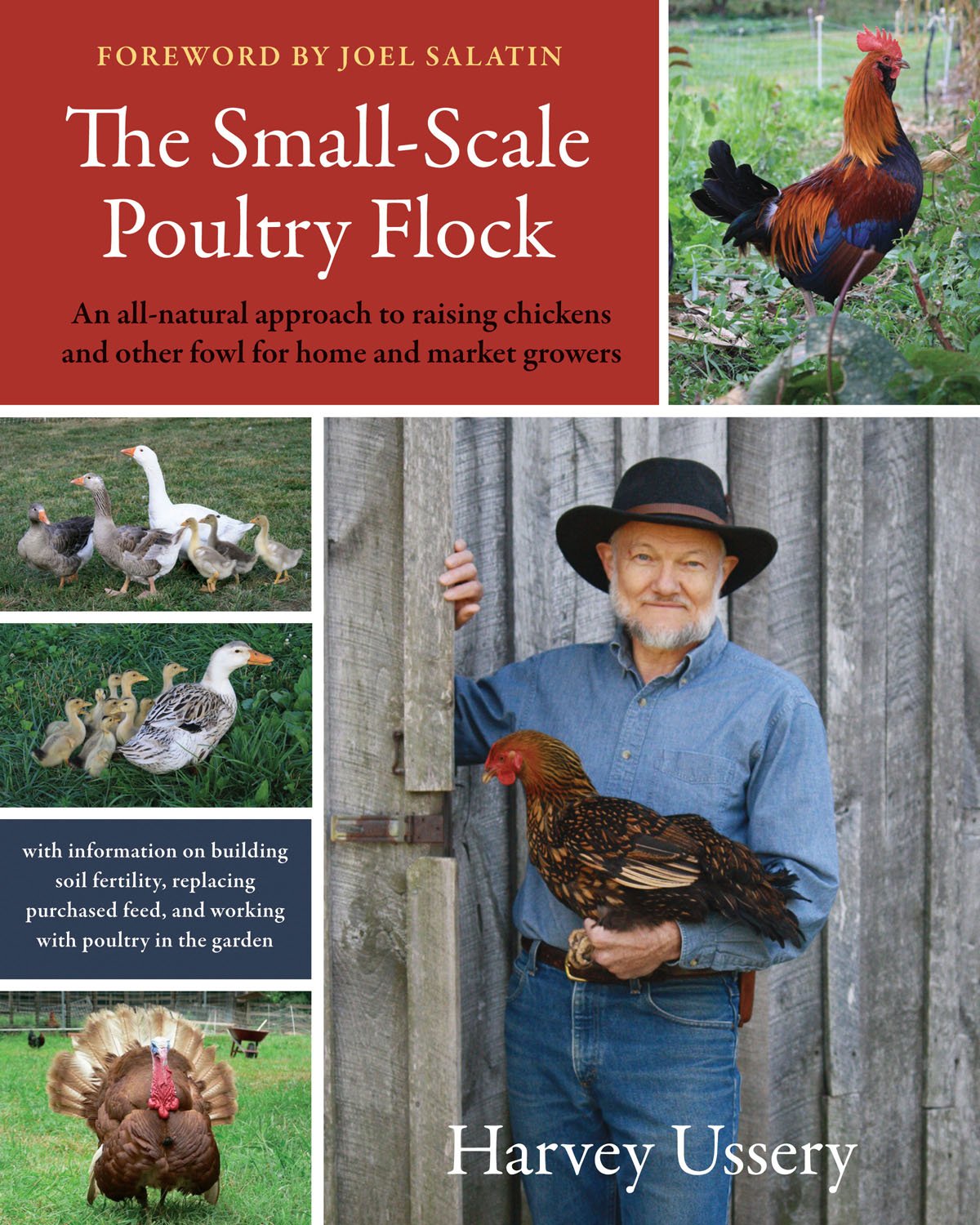
Giveaway: The Small-Scale Poultry Flock


As I mentioned in my book review of The Small-Scale Poultry Flock, I received two complimentary copies of this book.  So I'm hosting a giveaway to share the bounty with my readers.  This is a fantastic book for all homesteaders, urban chicken-keepers, and those who have yet to acquire their first small flocks.  If you haven't seen my review of it from last week, you may want to check that out.  By all means, do visit the author's website, The Modern Homestead.  It's full of thoughtful insights and useful information for anyone interested in moving towards self-sufficiency on a small acreage.

I mentioned that there was other news to do with Harvey Ussery.  I was thrilled to hear that he would once again be speaking at PASA's Farming for the Future Conference, which I attend each year in early February.  Hearing Harvey's presentation at this conference  four and a half years ago was what inspired me to start my own backyard flock.  But then, to my utter amazement I got an email from him a few weeks ago asking if I would like to co-present with him during his all day pre-conference homesteading track.  I went through a rapid series of thoughts and reactions, all centering on my paltry amount of experience as a homesteader compared to his two and a half decades in this vocation.  I was floored, honored, uncertain, hesitant, and thrilled.  In the end, I provided plenty of caveats, but ultimately said yes.  So!  I'm going to be presenting at next year's conference if only as a junior member to a seasoned and top-notch speaker.

I've encouraged my local-ish readers to attend this conference before, and I've written up summaries of things I've learned from this event in past years.  Now I can say, come introduce yourself to me at the conference.  Even if you've already read (right here on the blog) much of what I'll be talking about, you will learn a lot from Harvey Ussery, and I guarantee you'll come away loaded with enthusiasm and motivation.

Onwards to the giveaway.   Up for grabs is one copy of The Small-Scale Poultry Flock.  This is not exactly a freebie giveaway; I want something in exchange for your chance to win.  I'm asking for a comment with your best frugality, homemaking or small-scale homesteading tip.  I want to see some creative ideas here, people, not the obvious beginners-level ideas you find in the most simplistic magazine articles.  Tell me your secrets for saving energy, making a delicious meal on a dime, a great gardening trick, a labor-saving tip for any part of the homestead, a special recipe you use for canning, lacto-fermenting, or curing the foods you put up,  or anything else clever you've come up with that fits in a homemaking or homesteading category. 

Tedious stuff you should read anyway:  One entry per person.  Entries for this giveaway will be accepted until Wednesday, October 19th at 6pm, Eastern time.  You must either be signed in to some account that will easily and obviously lead me to a way to contact you, or else leave a means of contact in your entry comment.  Anonymous comments that do not include an email address will not be considered as entries for the giveaway. Winner will be chosen randomly from all valid entries, which must contain the aforementioned tip.  The winner will need to disclose (privately, to me only) full name and mailing address.  I'm opening the giveaway this time to readers from overseas, so get your comment-entries in.  I'll announce the winner by Friday, October 21st.  If I can't reach the winner in a couple of days, I'll select another and try again until it all works out.

Good luck!

Edit 10/19/2011: Comments are now closed.